Orchestrator-Worker Patterns for Coding Agent Pipelines
Build production coding pipelines with orchestrator-worker separation, isolation, and budgets.

Coding agent pipelines need dynamic delegation when the scope of the work becomes clear only as it runs. The orchestrator-worker pattern provides that flexibility, but production reliability depends on controls around the model. A working pipeline needs context isolation, clear delegation, budgets it can enforce, and execution it can audit to work beyond a demo.
Why orchestrator-worker is the pattern production coding pipelines converge on
A coding task may reveal which files need changing or which sources need checking only once it starts. A sequential pipeline assumes a fixed order, while parallel fan-out assumes a known set of independent subtasks. Neither assumption fits work whose decomposition depends on discoveries made during the run. An orchestrator instead reads the request, generates a plan at runtime, and dispatches workers as the task requires.
With this division, the orchestrator handles planning, synthesis, and error recovery while stateless workers do small, clearly defined tasks. One worker may query a database, another write code, and another call external APIs. A single agent handling all these domains accumulates irrelevant context and can exhaust its window. Delegation separates those workloads, but the freedom to create work also creates opportunities for excess calls, confused assignments, and uncontrolled context growth.
The internal architecture of a working orchestrator-worker pipeline
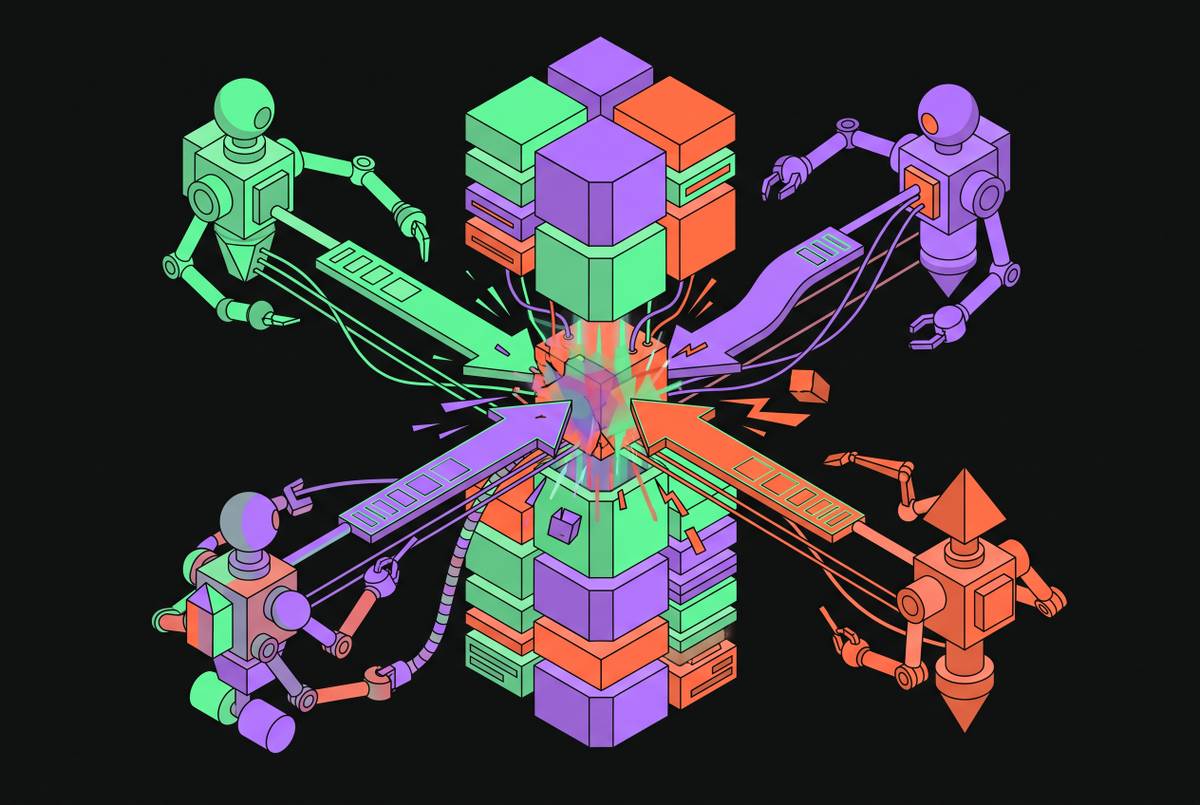
A working pipeline has four components, namely an orchestrator, a specialist worker pool, a context isolation boundary, and a synthesis step. The orchestrator holds the plan, selects workers, and decides whether they run in sequence, in parallel, or in a mixture of both. Workers carry out assignments with a clear scope and send short results back through the isolation boundary. Synthesis then combines those results and assesses task completion.
The orchestrator should keep worker summaries instead of raw output and leave the detailed execution to workers. Otherwise, it becomes both the planning bottleneck and the repository for every intermediate detail. Workers also should not get one another’s full context.
Claude Code follows this approach by keeping subagent contexts isolated. That isolation separates execution histories, but it does not replace a disciplined return contract. Claude Code’s official documentation states that the parent receives the subagent’s final message verbatim as the Agent tool result. A working pipeline therefore needs compact final messages and a synthesis gate with defined outcomes, which are success, flawed, blocked, or manual. Only success ships.
How the orchestrator-worker pattern breaks in production coding pipelines
Context window collapse begins when each worker’s output becomes permanent orchestrator context. As dispatches accumulate, that material can exceed the available window. Large-context models raise the threshold but do not remove accumulation. Before the hard limit is reached, bloated context can also degrade the planning that determines subsequent assignments.
Planning errors propagate differently. A misclassification at the orchestrator sends an unsuitable task to a worker, and further dispatches can carry the same mistaken interpretation. Unclear assignments lead workers to do the same work, while over-planning adds work that was never needed. A 14-step plan where three steps would suffice increases calls, latency, and opportunities for error without improving the decomposition.
Cost explosion has a separate multiplier. The orchestrator pays for decomposition and aggregation in addition to every worker call it generates. A workflow that costs little in tests can therefore cost a lot at production volumes, even when the cost of each call seems reasonable. Context compression does not prevent unnecessary dispatches, and precise dispatches do not impose a spending limit. Each failure requires its own control.
Why smarter prompting alone does not prevent these failures
Prompts can shape what a model chooses to do, but they cannot enforce system boundaries. An instruction to keep context short cannot stop an application from appending raw worker output. Asking for concise planning does not give each worker a typed objective or a testable completion condition. Asking an agent to respect a budget does not block its next call.
The controls must operate where the resource or action crosses a boundary. Context management governs what enters the orchestrator’s window, delegation contracts govern what workers undertake, and pre-call enforcement governs spending. Stop conditions and typed tool errors make these boundaries executable. Better prompting supports that architecture but cannot substitute for it.
Controlling context growth across orchestrator and worker boundaries
Context management starts with the full round trip, including what the orchestrator sends, what the worker returns, and what survives into the next round. Workers need scoped instructions. Their results need compression before they enter the parent context.
Claude Code’s AgentTool implementation provides a concrete isolation mechanism through isolated subagent context and a cloned file state cache. Its AbortController is independent for async agents but shared for sync agents. Workers exposed to other subtasks’ histories can become context-polluted, increasing token spend and degrading result quality.
Compression should activate at a defined threshold while enough context remains to apply it gracefully. Progressively summarize earlier results, drop verbose tool-call transcripts, and retain the plan skeleton and most recent worker output. Configuration also consumes this budget on every run. Keep AGENTS.md and CLAUDE.md to concise commands and hard rules rather than allowing standing instructions to crowd out task evidence.
Keeping delegation precise — how orchestrators should assign work to workers
The instruction boundary needs the same discipline as the return boundary. Each dispatch should carry a structured, scoped objective. It should specify the worker’s responsibility, expected output, tool guidance, and completion condition. Anthropic’s research team found that vague delegation duplicated work and addressed it with detailed task descriptions, explicit objectives, output formats, and clear boundaries.
Precision also means declining unnecessary decomposition. When a single well-scoped agent can finish the task, adding workers creates cost and failure surface without solving a structural problem. When delegation is necessary, defined run outcomes give workers a way to classify their results. A worker unable to distinguish success from flawed, blocked, or manual has not received a sufficiently clear assignment.
Versioned YAML configuration makes this contract reviewable. Defining each worker’s model, tool access, and prompt file in the repository exposes changes to the same review process as application code. The plan can remain dynamic while worker capabilities and constraints remain explicit. This separates runtime flexibility from ad hoc authority.
Budget controls that stop cost blowout before it happens
The system must enforce the budget before each LLM call. A central budget manager backed by a persistent store such as Redis or Postgres reserves spend, reconciles actual usage afterward, and blocks over-budget actions. Its limits should cover tokens, model calls, tool calls, retries, and dollars because each catches a different runaway pattern. A spending dashboard supplies evidence.
Automatic downgrade rules make the remaining budget actionable. At a defined threshold, routine planning switches from a frontier model to a fallback model. At a lower threshold, context compression activates. At a lower threshold still, tool gating disables web search first and then non-critical retrieval while preserving required database reads. These rules must run on their own, without waiting for a person to notice the trend.
Model tiering can lower the baseline cost by using a capable orchestrator with cheaper workers chosen for each task. Prompt caching, model routing, and the batch API for asynchronous work can cut costs further. Session-scoped credentials add a separate budget boundary when they expire or are revoked at session end. Embedding credentials in agent configuration instead exposes them through git history, logs, and potentially model context, undermining both cost control and security.
Observability and audit trails across the full orchestrator-worker call graph
Agent-level logging records only what the framework instruments. Generated code can make outbound calls outside that instrumentation, so infrastructure-level egress logging must capture traffic routed through the proxy. That record remains independent of agent code and uses a consistent, tamper-resistant format. The distinction is between observing framework behavior and observing outbound execution.
Shared trace IDs should link each orchestrator call, worker dispatch, and tool call back to the original request. This makes a cascading planning error reconstructable across sessions. Vercel AI SDK 7 provides lifecycle hooks across model calls, agents, tools, and other functions, recording their starts, model selection, token use, and completion. Microsoft’s Agent Governance Toolkit, open-sourced in April 2026, illustrates stronger audit integrity through a Merkle-chained audit trail and a Decision BOM.
Auditability also requires attribution to a person or trigger. Yet reviewing records afterward is insufficient when agents take many consequential actions per minute. Predefined interrupt conditions must pause execution for human review when monitoring detects anomalous patterns. The system needs its own stopping decision, separate from the model’s decision that the task is finished.
Security posture specific to coding agents with write access to source control and CI/CD
An agent that reads content has a different risk profile from one that writes to a production branch or uses deployment credentials. Coding agents can reach source control, CI/CD pipelines, and cloud APIs, while delegation multiplies the sessions holding that access. Permissions therefore need to be limited to the session’s assignment. Fresh credentials scoped to that assignment and revoked at session end limit the period and purpose of access.
Execution isolation must reinforce credential isolation. Each worker should run in its own sandbox so that a compromised or misbehaving worker cannot read a concurrent worker’s files or credentials. Framework context separation is useful, but infrastructure-level isolation provides a boundary independent of agent code. Install-time permission checks and state-machine gates should also block out-of-policy configurations before the model can invoke them.
These controls make prevention distinct from recording a violation. They constrain what an agent can do even when its instructions or generated code are wrong. NIST’s Center for AI Standards and Innovation launched the AI Agent Standards Initiative in February 2026. Teams that deploy coding agents in regulated industries should follow that work while keeping their current architectural controls in place as new guidance emerges.
Adaptive governance — promoting agents from assisted to autonomous as evidence accumulates
Agents start in assisted mode, where their outputs are reviewed, their tool calls are logged, and their budgets are kept low. Promotion depends on stable precision, low false-positive rates, and controllable replication behavior. Performance gates make the decision traceable instead of leaving it to confidence in a demonstration.
The evidence must show how agents behave on routine runs as well as in successful examples. Runs should succeed consistently, stay well below budget caps in routine work, and avoid repeated tool calls that suggest stuck states. Credential minting and revocation should behave as expected, with no anomalous access patterns in egress logs. Together, these records show whether the agent operates within the boundaries that greater autonomy would depend on.
Version-controlled YAML turns promotion into a reviewable change. Model selection, MCP server bindings, tool access, and prompt files become governance artifacts, with git history recording who approved each increase in authority and when. Teams that instrument from the start can use that evidence to move safely toward autonomy. Teams without it lack a basis for promotion and risk either permanent over-restriction or premature independence.
Running orchestrator-worker pipelines on managed infrastructure versus self-managed environments
Self-managed infrastructure can support every control described here, but teams must take on the work of running each one. Teams must maintain credential minting and revocation, a persistent budget manager, worker sandboxes, independent egress logs, and reviewable configuration. The burden compounds as more agents are deployed. For teams running more than a handful of agents, maintaining these controls tends to cost more than a managed platform.
Managed infrastructure can put those controls in the execution environment so teams do not have to rebuild them for each pipeline. The relevant capabilities are enforceable session, developer, and time-period spending limits, isolated sessions, and automatically attributable records of tool calls, diffs, and tokens. Repository-based agent definitions then connect deployment to review and promotion.
The deployment decision therefore turns on who operates the boundaries and how consistently they hold. Running Claude Code or Codex on a laptop demonstrates capability, but it does not establish production governance. A production pipeline must constrain delegation, preserve context boundaries, block excess spending, and record consequential actions regardless of where it runs. Managed infrastructure reduces the work of supplying those guarantees, while self-managed teams retain responsibility for every one of them.