Remote Agent Environments in Air-Gapped and High-Compliance Settings
Securing AI agents in air-gapped networks requires explicit control design, not cloud defaults.
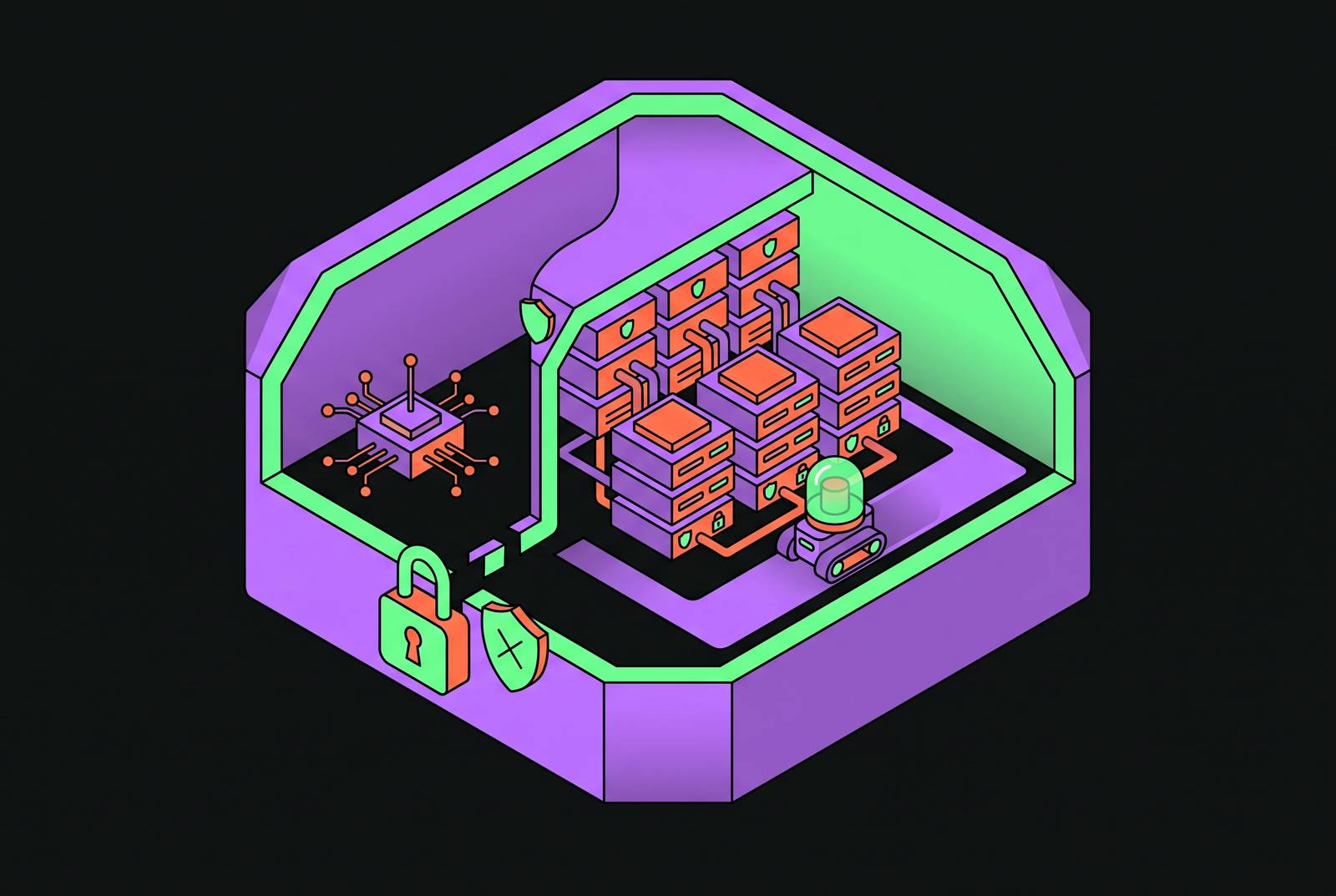
Coding agents are spreading through engineering organizations faster than the controls meant to govern them can keep up: 78% of engineering organizations already run AI agents in some form, while 69% have no security protections beyond ad-hoc controls against data exposure and secret leakage https://coder.com/blog/ai-agent-security-sovereignty-defense. Running those same agents inside an air-gapped or high-compliance environment doesn't just add friction to that gap, it removes every implicit safety net that cloud connectivity happened to provide, and forces a team to decide, explicitly and in advance, what sandboxing, credential handling, audit logging, and configuration management actually look like. Remote Agent Environments in Air-Gapped and High-Compliance Settings.
Why the air-gap changes the governance calculus entirely
Cloud-connected agent infrastructure comes with a set of guardrails nobody has to build because the platform already supplies them: managed identity handles credential lifecycle, the vendor's own logging captures what happened, and egress policy gets enforced somewhere upstream of the developer's laptop. Crossing into an air-gapped or high-compliance environment makes all of that vanish at once, not gradually. The identity provider is gone, the vendor-side logs don't exist, and the platform enforcing egress is no longer part of the picture.
Teams that try to lift a working cloud agent setup and drop it behind the perimeter run into this immediately. The tooling assumes call-home telemetry works, that remote model endpoints are reachable, and that credentials refresh automatically against a cloud IAM service. None of those assumptions hold on the other side of an air-gap.
The trickier part is that "the app is configured to stay local" doesn't mean the app actually stays local. Application-level configuration can address some of these, but not all five, and definitely not reliably.
That distinction (between an app that's been told not to call home and a machine that physically cannot) is the one most teams get wrong. "Network-restricted" means the app's policy says don't reach out. "Air-gapped" means the operating system blocks egress regardless of what the application tries to do. Most compliance incidents in this space live in the gap between those two states, where a team believes it has the second and actually only has the first.
Who operates in these environments and what compliance frameworks require of them
The regulated-industry footprint here isn't speculative. Defense and intelligence agencies, federal civilian agencies, healthcare organizations under HIPAA, financial institutions working under SOC 2 Type II plus sector rules, and critical infrastructure operators are already procuring air-gapped or near-air-gapped agent deployments. Federal AI funds obligated rose sharply between 2024 and 2026, and the Department of Defense alone accounts for 98.9% of federal AI contract spending. That's procurement moving faster than the security review processes most agencies built years ago were ever designed to absorb.
The standards bodies are trying to catch up. NIST NCCoE released a concept paper on software and AI agent identity and authorization in February 2026, preceded by a CAISI RFI and OpenID Foundation standards-track work in 2025. Singapore's IMDA moved on a parallel track, publishing its "Model AI Governance Framework for Agentic AI" in January 2026, extending existing guidance to cover delegation chains and multi-agent coordination explicitly.
None of this displaces the certifications regulated buyers already ask for. SOC 2 Type I gets a vendor into the conversation, nothing more. It's a starting point, not something a regulated buyer treats as a finish line. NIST CAISI issued a Request for Information on agent standards on January 8, 2026, marking the first formal U.S. government action of this kind.
Sandbox isolation as the foundational design decision
Every other control in this stack, credential scoping, audit logging, network policy, only works if the sandbox boundary is real and can be verified. A porous sandbox turns all of that downstream governance into theater: the logs look right, the credential scopes look right, but none of it means anything if the boundary they're supposed to protect can be walked through.
For multi-tenant or multi-agent deployments, the baseline is microVM isolation with a dedicated kernel per session, not container-level isolation. Containers share a kernel across workloads, and a kernel exploit in one container can reach every other workload on that host. A microVM doesn't have that failure mode built in.
In an air-gapped setting, there's no platform default quietly filling in the rest of the sandbox's boundaries, so the design has to state them. The sandbox needs its own filesystem namespace, defining what the agent can read and write and what stays off-limits. It needs its own network namespace, with default-deny egress and an explicit allowlist rather than an implicit one. It needs its own process space, with zero visibility into or interaction with any other agent session running on the same host. And it needs its own credential scope. The next section picks up there, but the boundary that makes that scope enforceable gets drawn here.
One more decision has to get made explicitly rather than left to whatever the framework defaults to: an environment must be designated as either ephemeral or persistent. A single PR review or a one-shot CI triage task should spin up, run, and tear down completely on completion. A longer-horizon task that needs to maintain state across multiple steps shouldn't. Leaving that choice to default behavior, rather than deciding it upfront, is how ephemeral tasks end up with persistent state they never needed, or persistent tasks lose context they required.
Credential scoping: why session-minted, session-revoked credentials are the only safe model
An agent run on a developer's local machine inherits access to whatever that machine can reach: environment files sitting in a home directory, SSH keys, internal network services the developer happens to have a route to. The scope of what the agent can touch is defined by what the developer has accumulated over time, not by what the specific task in front of it actually requires. That mismatch is the root cause behind a large share of agent-related credential incidents, and it's precisely the problem remote agent environments exist to eliminate.
Air-gapped environments make the consequences of getting this wrong worse, not better, because the usual instinct (that isolation equals safety) doesn't hold here. External connectivity, for all its risks, gives security teams a detection surface: outbound traffic to somewhere unexpected trips an alert. A credential misused entirely inside the perimeter, with that connectivity removed, may never generate an external signal. Containment has to come from limiting the blast radius before misuse happens.
The model that actually holds up is credentials minted fresh at the start of a session, scoped to exactly the repositories, services, and APIs that session's task needs, and revoked automatically the moment the session ends. No reuse across sessions. No ambient credentials the agent inherits just because they happened to be sitting in the environment. This is a narrower, more deliberate practice than most local-execution setups have ever required, and that's the point.
The NIST NCCoE's February 2026 concept paper puts a name on what this needs to produce as a record: every agent authentication event, every tool invocation, every delegation handoff, and every policy decision has to be captured, and the log has to record not just what happened but why, on whose behalf, and under what policy conditions it was allowed. Session-scoped credentials without that layer of recorded justification satisfy half the requirement. The audit trail is its own discipline.
What a governance-grade audit trail requires in practice
Standard application performance monitoring wasn't built for this workload, and it shows. APM tracks request rate, latency, error rate: the metrics that tell you whether a web service is behaving. APM reports a healthy system the entire time the agent's actual behavior, its quality and its security posture, is quietly degrading.
Agent observability needs three separate pillars, not one dashboard extended to cover a new workload. Traces have to capture the complete execution record: every LLM call, every tool invocation, every state transition, the full chain rather than just the entry point and the final output. Metrics aggregate the operational numbers, cost, latency, success rate, tool usage, the things a team watches to catch a budget overrun or a spike in failures. Logs are the structured, durable record that debugging depends on day-to-day and that a regulator or incident responder will ask for by name when something goes wrong.
The current state of this practice isn't reassuring. Only 38% of organizations monitor AI traffic end-to-end, across prompts, tool calls, and outputs together, and a considerably smaller share monitor agent-to-agent interactions on a continuous basis. In a cloud environment, a vendor's own logging can paper over part of that gap. Air-gapped environments don't have that option: external monitoring services aren't reachable, so the gap has to be closed with observability tooling that runs entirely inside the perimeter.
OpenTelemetry is the practical foundation for building that. It's become the standard for vendor-neutral observability: traces get emitted once and can route to any compatible backend without re-instrumenting the whole stack every time the backend changes. The OpenTelemetry Semantic Conventions for Generative AI supply the schema for model calls, tool invocations, and token usage, so teams aren't inventing their own taxonomy from scratch. Claude Code's CLI ships with OTel instrumentation already built in, and it activates through environment variables pointing at an OTLP endpoint, which matters a great deal for a self-hosted deployment that has to wire its own collector rather than lean on a vendor's.
Configuration as code: why agent definitions belong in the repository, not in a console
Changing an agent's permissions through a settings UI leaves almost nothing behind: no diff, no reviewer who signed off, no path to roll it back, no record of who made the change or when. Application code doesn't get treated this way in any serious engineering organization, and there's no principled reason agent configuration should get a lighter standard just because it's newer.
Version-controlled configuration closes that gap on several fronts at once. Capability changes go through pull request review the same way any other infrastructure change does. A misconfigured agent reverts to a known-good state the same way a bad application deploy does. The git history becomes the audit trail itself, recording who approved what scope and why, which is a much stronger artifact than a settings page that only shows the current state. And any environment can be rebuilt from the config file in an identical state, which removes the drift that occurs when two environments were configured by hand at different times.
The "Clinejection" episode makes the stakes concrete. Cline added an AI-powered issue triage workflow, and its configuration set allowed_non_write_users to "*", so any GitHub user could trigger the bot just by opening an issue. The bot itself carried Bash, Read, Write, Edit, Glob, Grep, WebFetch, and WebSearch access on its Actions runners. Nothing about this was a code vulnerability in the traditional sense. It was a configuration decision (an overly permissive allowed_non_write_users: "*" setting letting any GitHub user trigger a bot with Bash, Read, Write, Edit, Glob, Grep, WebFetch, and WebSearch access on Actions runners) that granted far more trust than the workflow needed. A configuration review gate, the kind that a pull-request-based process forces by default, would have caught it before it shipped.
That's the actual argument for checking agent config into the repository: every change to what an agent can do, what credentials it receives, what tools it's allowed to call, and what budget it carries becomes a reviewable diff. No capability expands without somebody's name attached to the record of why.
Budget controls and cost governance when there is no cloud billing console to catch runaway spend
A LangChain multi-agent system once ran an infinite loop for eleven days, racking up $47,000 in API charges before anyone caught it. That's the cloud version of the failure mode. Behind an air-gap, running local inference instead of a metered API, the same loop doesn't generate a bill at all: it generates compute exhaustion and, depending on how the job queue is built, starvation of every other task waiting behind it. Arguably that's worse, because there's no invoice arriving to force someone to notice.
Managed cloud providers give a team post-hoc spend visibility almost as a side effect of billing them. Self-hosted inference running inside a perimeter produces no external invoice for anyone to review. Cost governance has to be built into the execution layer itself rather than bolted on as a dashboard someone checks later. Hard caps have to exist before a session starts, not get discovered after it's already run over budget.
Three levers have to work together for this to actually hold. Hard budget caps enforced at session start, so a session projected to exceed its allocation either doesn't start or gets terminated mid-run before the cap breaks, rather than getting flagged in a report the next morning. Hierarchical budgets, with caps set at the session level, the developer level, the team level, and the time-period level, so one runaway agent can't quietly eat into budget that belongs to a different team or a different sprint. And per-key rate limiting, so an agent stuck in a loop gets throttled before it exhausts the resources behind it, rather than after.
None of that works without knowing where the tokens actually go. Every request an agent makes consumes prompt tokens, tool tokens, memory tokens, and response tokens, and folding all of that into a single input/output number hides exactly which stage of the pipeline is expensive. Attribution has to be built in per-user, per-task, and per-agent from the start, because budget enforcement is only as precise as the accounting that produces it, and no amount of hierarchy or rate limiting fixes a system that can't tell you which agent, which task, or which user actually spent the money. Production cost control requires three levers working together. A proper air-gap implementation must address five network egress vectors for an AI coding environment https://www.bodegaone.ai/blog/air-gapped-ai-coding-guide-2026.