Remote Development Environments for AI Coding Agent Workloads
Agent workloads need isolation, ephemeral credentials, and hard cost ceilings.
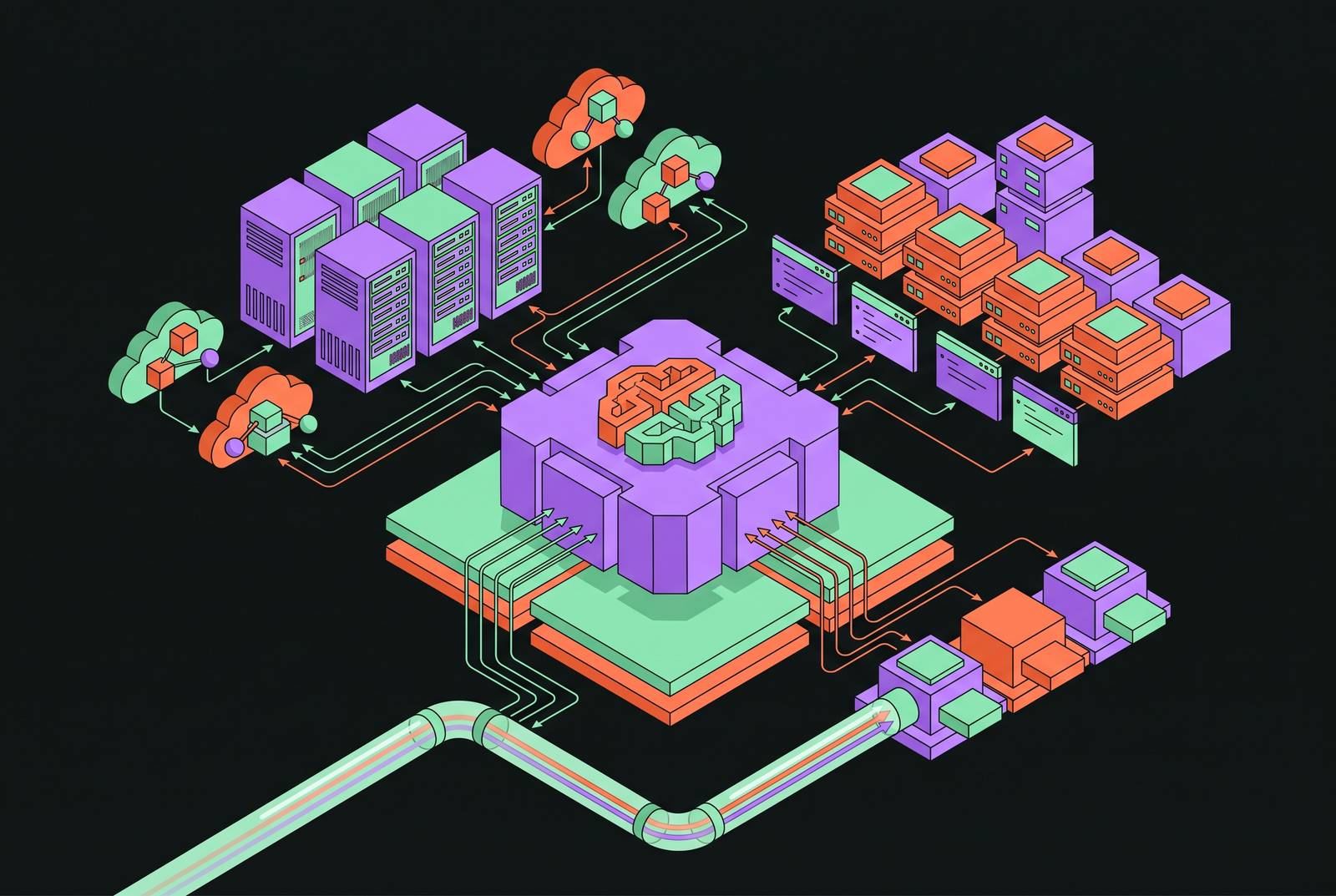
Running an AI coding agent at scale breaks the assumptions that remote development infrastructure was built on. A human developer opens a terminal, works for a few hours, and pushes a handful of commits; an agent opens dozens of sessions at once, fires off tool calls at machine speed, and can burn through credentials, compute, or a cost budget before anyone notices. This piece maps what remote environments actually need to provide to run agent workloads safely: isolation, ephemeral credentials, cost ceilings, full observability, and configuration that lives in the repo rather than a dashboard. Most teams running agents today are still governing them like a contractor on a handshake, checking in occasionally and trusting self-reporting, and that model breaks the moment one engineer can trigger forty concurrent sessions before lunch.
The asymmetries are worth naming plainly. One engineer can spin up tens of concurrent agent runs where a human opens one IDE window at a time, and an agent can write, execute, and push code before a reviewer even sees the notification. That pushes blast radius well past what code review timelines were built to catch. Local execution means the agent inherits whatever the developer's machine can reach, cloud credentials, SSH keys, internal network routes, all of it, with no gate in between. Structured logs worth auditing rarely come from human keystrokes; agent tool calls have to be captured on purpose, or there's nothing left to review later.
Northflank's estimate that roughly 65 to 70% of enterprise code is now AI-written makes the question no longer theoretical. The live issue inside most organizations is where agents run, what they're allowed to touch, and whether any of that activity can be reconstructed after the fact.
What "isolated execution" actually requires at the environment level
Isolation is a stack of decisions about kernel boundaries, network reachability, and how far into the filesystem a session can see. Most teams get this wrong in the same direction: they pick the fastest option instead of the correct one, and the correct one is rarely Docker.
Firecracker microVMs give each session its own kernel with almost no shared surface between tenants. gVisor-isolated containers intercept syscalls instead of running a full VM, trading some raw performance for containment. Kata Containers offer OCI compatibility with VM-grade isolation and are another option teams reach for when stronger containment is required. Plain Docker containers are the fastest option and the weakest one: they share a kernel with the host, which is a real liability the moment the code inside is untrusted or multiple tenants sit on the same box. Reaching for Docker because it's familiar, rather than because it's sufficient, is the single most common mistake teams make when they stand up agent infrastructure for the first time, and it deserves to be called a mistake rather than softened into a tradeoff.
Whatever the mechanism, isolation at the session level has to enforce a few things without exception. Network egress needs to be locked down so the agent reaches only endpoints it's explicitly cleared to call. Filesystem scope has to exclude host paths, sibling sessions, and anything sitting in a developer's local secrets store. Process boundaries need to stop an agent from spawning something that outlives the session's own teardown.
The comparison to local execution makes the stakes concrete. An agent running on a laptop inherits everything that laptop can reach, no exceptions, no configuration required. Remote execution flips that default: access has to be explicitly granted through configuration rather than assumed from whatever happens to be mounted on someone's machine. Devin runs each agent task in its own VM with its own environment, and that design choice says something worth sitting with. The more autonomous the agent, the stronger the isolation underneath it needs to be.
None of the controls that follow work without this. Credential scope, cost ceilings, and audit trails all depend on sessions not sharing a kernel or a filesystem in the first place.
Ephemeral credentials: why minting fresh and revoking on completion is the only safe model
A static API key sitting in an environment variable was built for a human session lasting hours. An agent can exhaust that same permission set in minutes, and if the credential leaks mid-session, through a log line, a tool call response, or a prompt injection, it stays valid until someone manually rotates it. Static credentials also erase attribution: there's no way to tell which agent run used a given key, on what task, triggered by whom.
The fix is straightforward in concept, even if it takes real engineering to operationalize. Mint credentials fresh at session start, scope them to exactly what that session needs, and revoke them the moment the session ends. No credential should outlive the work it was issued for. Tie each one to a session ID, and every downstream API call becomes traceable back to a specific trigger and a specific person.
Shared static credentials produce a weak attribution signal no matter how good the logging is downstream; ephemeral, session-scoped credentials close that gap directly. The connection to compliance work predates agents entirely: GDPR, HIPAA, and SOC 2 all require demonstrable access controls and records of who accessed what. Session-scoped credentials are the technical primitive that makes those records trustworthy instead of aspirational.
In practice, the remote environment needs real integration with a secrets system, whether that's Vault, AWS IAM role chaining, or cloud-provider OIDC, capable of issuing and revoking short-lived credentials per session. Injecting one static secret at container start and calling it done doesn't clear the bar anymore. Any team still doing that is operating on borrowed time.
Resource ceilings and cost caps as first-class infrastructure controls, not afterthoughts
Agent workloads burn tokens and compute at a pace no human developer approaches. A misconfigured loop, or an unexpectedly large repository, can rack up costs in minutes that would take a person a week of manual effort to approach.
Cost control at the infrastructure level has to mean something specific, and soft alerts don't qualify. Session-level token and compute budgets need to be hard ceilings, so the session actually stops before it overspends rather than after. Rollups need to exist at the developer and team level, so someone can ask how much a given engineer's agents spent this sprint and enforce a cap against it. Time-period limits, daily or monthly, need to apply before the spend happens, not surface in a report a week later.
Monitoring after the fact doesn't hold up here, and this is where most cost-control setups quietly fail. By the time a cost alert fires, the session already ran; the only move left is a reactive investigation instead of prevention. At the level of parallelism agents introduce, retrospective monitoring is structurally too slow to matter.
Session persistence choices reflect this tension directly. Some platforms support long-running sessions with snapshot and restore capabilities, while others impose short idle timeouts by default. Neither number is arbitrary; both represent a deliberate tradeoff between letting a long task run to completion and capping the damage from a session gone sideways. The right choice depends on what the agent is actually doing, not on which default ships out of the box.
Worth being blunt about: the scaffolding around a model matters as much as the model itself. SWE-bench results show harness architecture driving benchmark performance in its own right, so two teams running the identical model on different infrastructure can land on meaningfully different outcomes. Choosing infrastructure carries real performance consequences alongside cost ones. Treating it as a pure line-item expense misses half of what it's actually doing.
Full observability of every tool call, diff, and token as the operational baseline
Observability for an agent means something different than it does for a typical application. The question isn't just whether the session succeeded, but which tools got called, in what order, with what arguments, and what the agent reasoned through between one call and the next.
Every diff an agent produces, every file it reads, every API it touches needs to be recorded and tied back to a session ID, and from there to a person or a trigger. In environments where chain-of-thought reasoning surfaces, those thinking tokens belong in the audit record too, since they show why an agent took an action rather than merely confirming that it did.
Granularity is where most teams get it backwards: they log the prompt and assume that's enough. Session-level success or failure is too blunt an instrument to diagnose a partial failure or investigate a security incident, and prompt-level logging captures what the agent was asked to do but not what it actually did to the system once it started running. Tool-call logging closes that distance. A team relying on prompt logs alone is reconstructing incidents from memory, not from record, and that gap only shows up once it's too late to close it.
A study of agentic pull requests, covering 8,031 PRs across 1,605 GitHub repositories, found that CI/CD configuration files made up 3.25% of all agent-driven changes overall, with Devin at 4.83% and Codex at 2.01%. Agents are editing pipeline definitions alongside application code, and a team that can't say which session touched a workflow file is blind to one of the highest-stakes change categories there is. The same study found agentic PRs with CI/CD changes merged at a rate of 67.77%, against 71.80% for changes that didn't touch CI/CD. The gap is modest, but it's real, and the only way to understand why it exists is to have the underlying tool calls logged and reviewable rather than lost to a black box.
What this demands architecturally is structured, machine-readable logging rather than free text, so a question like "show every session that touched a secrets file this week" has an actual answer. Logs need immutable storage tied to session IDs, and they need to plug into existing SIEM or security tooling instead of living in some separate dashboard nobody checks.
How agent configuration belongs in the repository, not in a UI or a runbook
An agent configured through a UI, or tweaked ad hoc by whoever's on call, has no review step by design. Its permissions, its tools, its scope can all shift without a pull request, without a reviewer, without any history attached. Configuration drifts quietly until what the agent does in production no longer matches what anyone remembers signing off on. If it starts behaving badly, there's no clean rollback, just manual reconstruction of a state nobody wrote down. This is the failure mode that quietly ends up in postmortems: a permission set nobody can trace back to a decision.
The alternative already has a name: agents as code. Agent definitions live as YAML or other structured config, checked into the same repository as the code they operate on, and changes to an agent's scope, its tool access, its permissions go through the identical PR review process as any other code change. The repository becomes the one place that says, definitively, what an agent is allowed to do.
This pattern is showing up across the ecosystem in ways that suggest convergence rather than coincidence. OpenAI's Codex agents use project-level AGENTS.md files to define scope and instructions. Emerging platform tooling wraps agents in kernel-level isolation governed by declarative YAML policies covering filesystem, network, process, and inference controls. Claude Code similarly uses project-level configuration files to scope what an agent can do.
Version-controlled configuration buys real operational benefits. There's an audit trail for every change, so it's possible to answer who approved expanding an agent's network access and when. The same config file produces the same behavior in any environment, which makes reproducibility a given instead of a hope. A new agent configuration can be tested on a branch before it ever touches main.
The governance logic underneath all of this is simple. Isolation, credentials, and cost caps are runtime controls that enforce boundaries while a session is live. Version-controlled configuration is the design-time control that decides, ahead of time, what the runtime is even allowed to enforce.
Where managed cloud platforms fit relative to self-hosted and local execution
Three deployment models cover most of what's actually in use, and the honest answer is that one of them is wrong for nearly everyone reading this.
Local execution, an agent running on a laptop or a developer's own workstation, starts fast and needs no infrastructure at all. It also comes with no isolation boundary, no credential scope, and no audit trail unless someone builds one on top of it by hand. That's fine for a solo engineer experimenting on a Friday afternoon; it carries real risk once a team is involved, and treating it as a production model is how a leaked credential ends up described in an incident report instead of caught by a config file that never granted it in the first place.
Self-hosted remote environments, where a team builds its own sandbox infrastructure on cloud VMs or Kubernetes, offer full control over isolation technology, network policy, and data residency. The cost is operational: someone on that team now owns credential vending, log pipelines, cost accounting, and sandbox lifecycle management, built and maintained from scratch. That's defensible for an organization with a dedicated platform team and strict residency requirements. It is not a small commitment, and most teams underestimate the maintenance load until they're six months into owning it and realize the on-call rotation now includes a homegrown secrets broker.
Managed cloud platforms built specifically for agent execution handle isolation, ephemeral credentials, cost caps, and observability as primitives rather than things a team has to build. Northflank offers SOC 2 Type 2 certification, enterprise SSO, audit logs, VPC deployment, and unlimited session duration, alongside a complete cloud platform that includes managed databases next to sandboxed execution. Modal runs on gVisor isolation, carries SOC 2 Type 2 and HIPAA eligibility on its Enterprise plan, and supports sessions up to 24 hours with snapshot and restore.
For most organizations, self-hosting is the wrong default, full stop. The decision comes down to one variable: how much sandbox infrastructure a team's engineers actually have the bandwidth to build and run themselves. That answer is almost always smaller than the team assumes going in. Managed platforms trade away some configuration flexibility for a guarantee that isolation, credential lifecycle, and audit logging are handled correctly from day one, rather than assembled piece by piece under deadline pressure. That trade suits any team without a dedicated platform group whose full-time job is exactly this, which describes most teams.
Capability is no longer the bottleneck, either. SWE-bench scores for top models and scaffolds have climbed to somewhere between 70 and 90% success, up from roughly 4% in 2023. The constraint has moved, and it now sits squarely on the governance and reliability of the environment the agent runs in, separate from what the model itself can do. For teams already operating under SOC 2, HIPAA, or GDPR, the practical move is to favor platforms that carry those certifications natively rather than trying to bolt compliance onto infrastructure that was never built with it in mind.