Scaling Remote Agent Environments Across Large Engineering Organizations
Organizations must treat scaled agent deployments as infrastructure, not tools.
What "fleet scale" means for assumptions built for single-developer agent use
Software teams spent 2023 and 2024 teaching AI to finish their sentences with code completion, then IDEs with chat panels bolted on, a stopgap that never addressed real delegation. That era is over. The work has moved from assistance to delegation. Engineers now hand off whole issues, whole test suites, whole migrations to agents that run for minutes or hours without anyone watching each step. Uber rolled Claude Code out to about 5,000 engineers in December 2025, and by March 2026, 84% of its developers counted as agentic coding users.
That kind of scale turns agent use into a governance problem, and it demands the same discipline teams already apply to isolation, credentials, monitoring, and cost control on any system that touches production. No exceptions, and no grace period for agents just because they're new.
The distinction matters because delegation looks nothing like autocomplete. A single-prompt tool answers a question and stops. An agent invokes a tool, reads the result, decides what to do next, and keeps going, sometimes across dozens of steps, sometimes across hours. That loop is what an organization has to govern like infrastructure, more than the model underneath it does. The chain of actions an agent produces is what needs watching, and most engineering orgs still aren't watching it.
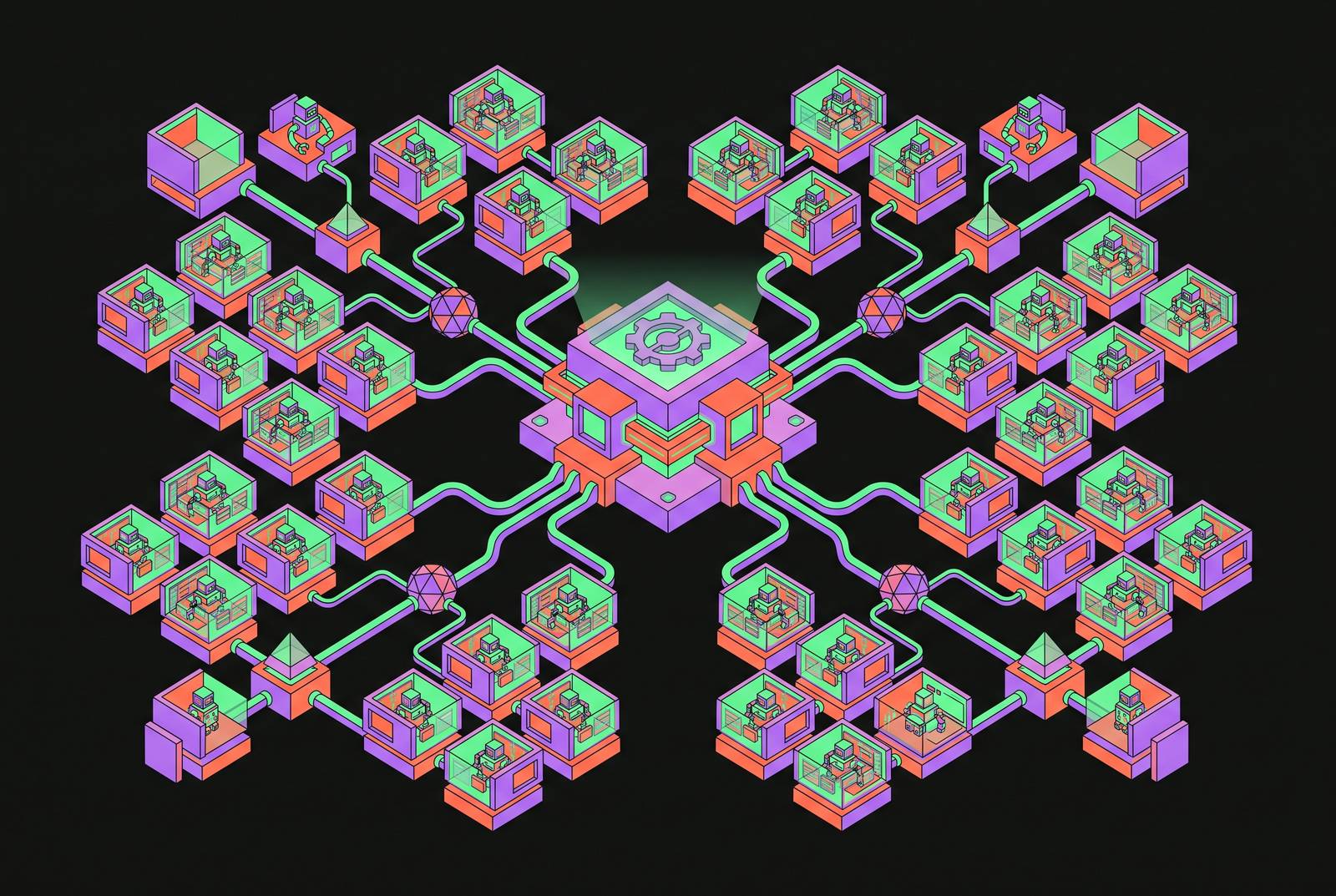
One developer running one agent against one repo fails in small, local ways: a bad diff, a wasted afternoon, maybe a broken build caught in review. None of that generalizes to what happens when a few hundred engineers run agents concurrently across a shared codebase, shared credentials, and a shared budget. At that point, agents stop being tools an individual controls and start being infrastructure the organization runs, planned for or not.
Nobody would let five hundred engineers share one root password to production. Yet that's roughly the posture many teams default into once agent use scales past a pilot. The cause isn't negligence so much as the fact that nothing about single-developer tooling ever forces the question.
The shift toward multi-agent pipelines makes this worse, not better. A Planner breaks the task down, an Architect designs the approach, an Implementer writes the code, a Tester checks it, a Reviewer signs off. Each agent owns a narrow role, which sounds like clean separation of concerns until you notice what it actually introduces: drift. Semantic drift happens when an agent's output stays syntactically valid but slowly stops matching what was asked for. Coordination drift happens when agents in the pipeline lose sync on shared state. Behavioral drift happens when an agent's decisions shift over a long session in ways no single step would ever flag as wrong. None of these appear in an inspection of one agent in isolation. They become visible only at the fleet level, and most tooling in production today was never built to look there.
Isolation architecture: why every agent session needs its own sandbox
On December 21, 2025, Cline shipped an AI-powered issue triage workflow with a configuration flaw: allowed_non_write_users: "*", which let any GitHub user, not just maintainers, trigger the bot. The bot ran with Bash, Read, Write, and Edit access on Actions runners and held permissions on the repository. That combination, not any single piece of it, is what turned a routine feature into an incident.
An attacker planted a prompt injection payload inside a GitHub issue. The triage bot read it, got hijacked, and ran malicious code on the Actions runner. That code poisoned the shared Actions cache. When the nightly release workflow later pulled from that same cache, it picked up the poisoned artifacts and leaked npm publishing credentials. An unauthorized version of Cline sat live on npm for roughly eight hours, racking up about 4,000 downloads, some to developers with auto-updates enabled who had no idea anything was wrong.
The lesson sits at the tool execution boundary, not with the model. The LLM did what LLMs do: it followed instructions found in its context, including instructions an attacker planted there. An agent's tool calls touching real infrastructure with real permissions marks the real failure point, and security teams say the danger now concentrates exactly there. 48% rank agentic AI as the top attack vector heading into 2026, ahead of other leading threat categories.
The fix isn't exotic, and it isn't new. Every agent session needs its own sandbox: not a shared runner, not a shared workspace, not a shared cache that persists state between unrelated jobs. Isolate the blast radius per session, and a compromised agent run stays a compromised agent run instead of becoming a compromised release pipeline. Anyone still running agents on shared infrastructure to save on setup cost is trading a small convenience now for a much larger cleanup later.
Credentialing at session scope: the non-human identity problem agents introduce
Agents hold access to sensitive systems while sitting outside almost every control built for humans. No badge, no manager, no offboarding checklist when a session ends. That's a structural gap, and scale doesn't shrink it. It multiplies it.
Run a few hundred agent sessions at once across an engineering org, each holding some set of credentials to touch code, run tests, or call internal APIs. If those credentials are shared across sessions, static instead of rotated, or scoped broadly instead of narrowly, the attack surface stops being theoretical. It becomes the Cline incident, waiting on the next misconfigured permission to trigger it. Visibility hasn't caught up: only 21% of executives say they have full visibility into what permissions their agents hold, what tools they've invoked, or what data they've touched.
The Cloud Security Alliance's Agentic Trust Framework applies zero-trust principles to agent sessions, the same posture already applied to human users and service accounts. Credentials get issued per session, scoped to what that session actually needs, and expired the moment the session ends. Nothing persists longer than the task requires, and nothing should.
Static, broadly-scoped credentials handed to a persistent agent identity are the wrong default, full stop. Anything less than per-session issuance just delays the incident.
Observability across the full agent execution chain, not just the output
Watching the final diff tells you almost nothing about what happened to produce it. As of March 2026, only 38% of organizations monitor AI traffic end-to-end across prompts, tool calls, and outputs, and just 17% continuously monitor agent-to-agent interactions. That gap is where the real risk lives, and it's the same gap the Cline incident fell straight through.
Standard CI/CD checks catch broken builds and failing tests. They miss spec drift, where code passes every test but no longer does what the ticket actually asked for. They miss hallucinated dependencies, where an agent imports a package that doesn't exist or behaves differently than it assumed. And they miss the drift described above entirely, because drift accumulates across a chain of tool calls and decisions, never inside any single commit. The Cline prompt injection makes the point sharply: nothing in the final output looked wrong. The compromise is visible only in the sequence of tool calls that led there, a layer most teams simply aren't logging.
Full-chain observability means logging every tool call and tying it back to whoever or whatever triggered it, not stopping at the diff. It means capturing intermediate reasoning steps, not just final answers, since drift is usually visible there first. It means tracking faithfulness and hallucination rates as ongoing signals, not something checked once during a model evaluation months back. For multi-agent pipelines specifically, it means real-time detection of semantic, coordination, and behavioral drift across the whole chain at once.
MLflow's production-readiness guidance points at the right structure: put evaluation probes inside the agentic workflow itself, so auditability happens as the agent runs, rather than as a separate pass bolted on afterward. Watching outputs alone and calling it observability is a category error, not a shortcut.
Cost control as a governance requirement, not an optimization afterthought
Enterprise AI spending grew 483% from 2024 to 2026, while per-token prices fell roughly 80% over the same stretch. Those two numbers should not coexist if the systems spending the money were under control. Agentic workflows burn far more tokens per task than anyone budgeted for, and most organizations still can't see which agents are driving that number up.
The mechanics aren't mysterious once you look at them. A simple prompt-response exchange might cost two cents. Route the same task through an agentic workflow, with tool calls, context window management across a long session, and iterative reasoning where the agent tries something, checks the result, and tries again, and that one task can land anywhere from fifty cents to two dollars. Multiply that across hundreds of concurrent sessions and forecasting becomes a guessing game: forecasting becomes a guessing game, and Gartner predicts that 40% of enterprise applications will embed AI agents by the end of 2026, a scale that makes cost control increasingly urgent.
This is not a rounding error. Cost governance for agent fleets is the same discipline that keeps a cloud bill from turning into a surprise, applied to a system that spends money every time it thinks. Treating it as a line item to review quarterly lets the bill run past you by the time anyone looks. It belongs in the same review cycle as sandboxing and credentialing, not off to the side with finance.
Agent configuration as code: how versioning and review extend to agent definitions
An agent configured through a shared UI, or through undocumented environment variables someone set six months ago and forgot about, can't be audited. It can't be reviewed before a change ships. It can't be rolled back cleanly. It sits outside the entire governance model the rest of the engineering org already runs for application code, which makes it the weakest link almost by construction.
Agents-as-code fixes this by treating agent definitions the way teams already treat infrastructure: version-controlled configuration, written in something like YAML, checked directly into the repository next to the code it operates on. A change to what an agent can do goes through the same pull request, the same review, the same CI gate as any other code change. Rolling back a bad agent configuration becomes a git revert instead of a scramble to remember what the old settings were. The constraints that matter most, what the agent can access, which tools it can invoke, what budget it can burn through, get declared explicitly in that config file instead of set ad hoc by whoever happened to wire up the integration.
This matters even more in multi-agent pipelines. When a Planner hands work to an Implementer, which hands its output to a Reviewer, each handoff should be a declared, reviewable step in a config file, not an emergent behavior of some orchestration layer nobody fully documented. Open protocols like MCP and A2A push in the right direction here: they turn agent capabilities into declarable, auditable interfaces instead of opaque integrations only the original builder understands.
Which tasks to automate first
By 2026, agents in real organizations handle bug fixes, feature implementation, refactoring, test generation, migration work, PR preparation, code review, and CI triage. That's a wide range, and treating all of it as equally safe to delegate is the mistake most teams are still making.
Start with tests, boilerplate, mechanical migrations, and documentation. That category shares three traits that make it the right first target: there's a lot of it, it's cheap to check whether the output is correct, and getting it wrong doesn't cost much to fix. Save core business logic for later, once the sandboxing, credentialing, and observability described above are actually built and running, not promised.
Nubank's migration makes the point concretely. Using Devin, the team completed a migration of more than 100,000 data class implementations and finished it in weeks, with a reported 8–12x gain in engineering efficiency. That result didn't come from pointing an agent at the hardest, highest-stakes part of the codebase first. It came from picking work where volume is high, verification is cheap, and a mistake stays small. That's the category most teams should automate before anything else, and it's the one most teams skip past on the way to something flashier.