Codex vs Claude Code for Production Engineering Workflows
Codex and Claude Code split on where agents run, reshaping production engineering tradeoffs.
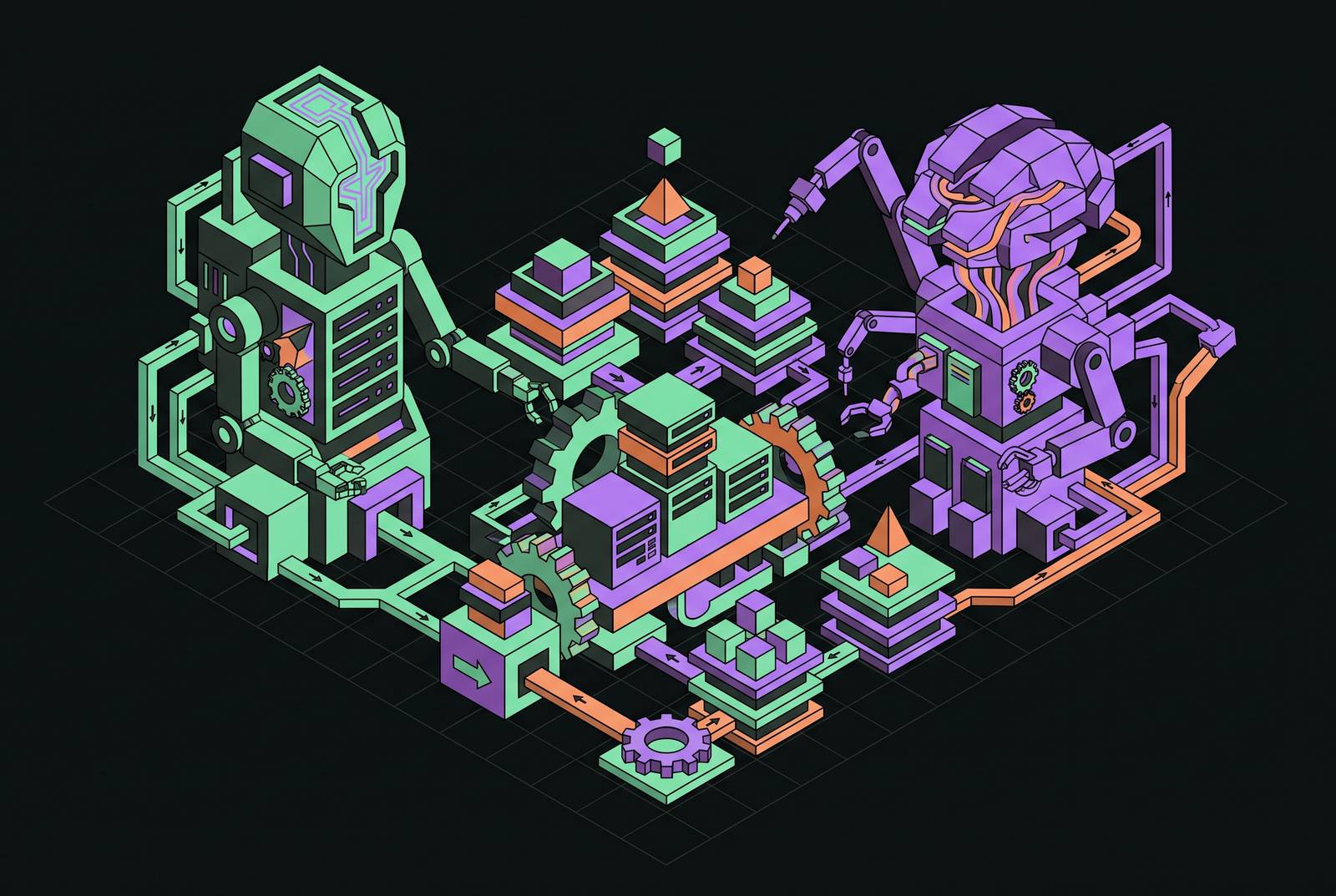
Codex and Claude Code solve the same broad problem, getting software written and shipped with less human typing, but they start from opposite bets about where an agent should live and who should watch it work. Both have moved well past the pilot phase: Codex now counts millions of weekly active users, and Dario Amodei has confirmed that more than 80% of the new code merged into Anthropic's own production codebase in May 2026 came from Claude, with the average Anthropic engineer merging many times more code per day than in 2024. That kind of adoption means the choice between these tools is no longer academic.
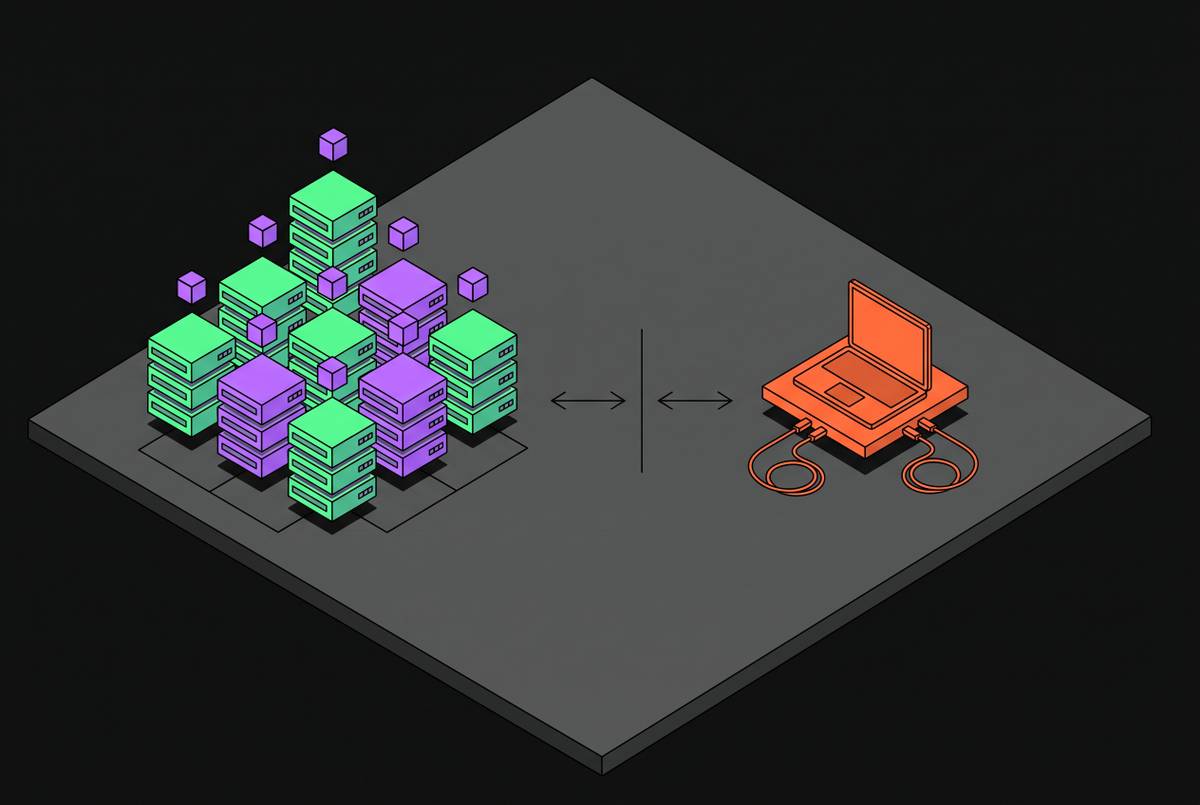
The split comes down to where the work actually runs. Codex fires a job from the terminal, but the execution itself happens inside a cloud sandbox that OpenAI manages by default. Claude Code, on the other hand, behaves less like a single assistant and more like what practitioners call an Agent Operating System: it holds persistent memory, spins up specialized subagents for sub-tasks, and enforces whatever organizational rules a team builds in, all while running locally or on infrastructure the developer controls.
That one design choice, cloud sandbox versus local operating system, sets up almost every trade-off that follows in this piece. Parallelism, governance, cost, and audit trails are downstream consequences of a single upstream choice each vendor made about where the agent actually executes. They're downstream consequences of where the agent actually executes and who owns that environment. Picking one tool over the other is really picking one of two coherent theories about how agent infrastructure should be built, not choosing a brand.
What each tool is optimized to do in a production engineering loop
Codex is built for work that doesn't need a human in the loop step by step: dependency upgrades, expanding test coverage, migrating code style, writing documentation, and fixing bugs off an issue description. Running many of them at once, in isolation, matters more here than back-and-forth refinement with a person. The clearest evidence of this in production comes from Harness Engineering's internal deployment, where every line of code, application logic, test, CI config, doc, observability hook, and internal tool has been written by Codex. With GPT-5.5 behind it, the CLI holds up across multi-hour autonomous sessions on real engineering tasks, and OpenAI's own research on how agents are changing work found that 70.2% of sampled individual Codex users by May 2026 were asking for tasks estimated to take more than an hour of human effort�block. Codex also has a feature with no real counterpart on the other side: Best-of-N, which generates several different implementation approaches before picking one to execute.
Claude Code is built for something else: long jobs that need a lot of context held in the model's head across many files at once. By early 2026 the model family had settled into three clear tiers, Opus 4.5 for architectural refactors and orchestrating multiple agents, Sonnet 4.5 for feature work and writing its own tests, and Haiku 4.5 for fast debugging and CI/CD chores. Anthropic's own engineering team gave a good example of this in April 2026, using Claude to clean up a persistent class of API errors that had built up across the codebase, tracking edge cases across dozens of separate call sites, exactly the kind of cross-file, long-memory problem the operating-system model is built to handle. On the benchmarks, there isn't much daylight: on SWE-bench Verified and the tougher SWE-bench Pro, the top models from both companies land close together, trading narrow leads depending on which benchmark and which snapshot date you're looking at.
What's telling is that engineers using both tools in the wild have settled into a pattern nobody had to invent for them. Practitioner Zack Proser described a two-tier workflow: Codex handles routine SDLC maintenance, with four or five tasks queued up in parallel first thing in the morning, and Claude Code gets pulled in when the problem turns architectural. That split says something the benchmarks can't: these tools are built for different moments in a workflow. They're built for different moments.
Parallelism: Codex's cloud orchestration versus Claude Code's infrastructure dependency
Codex's cloud sandbox architecture turns parallel execution into something closer to a default setting than a stretch goal. Every task spins up its own cloud environment with the repo already loaded, so five independent features or bug fixes can run at the same time from a single dashboard, with no extra plumbing required. At the extreme end, OpenAI's own data shows users at the 99th percentile inside the company routinely generated more than 60 hours of Codex agent turns per day by June 2026, spread across multiple agents running at once.
Claude Code doesn't get this for free.
None of this makes Codex's model strictly better, though. It just moves the constraint somewhere else, and that somewhere else tends to be worse than the original bottleneck if nobody's watching for it. Fiona Fung, who leads engineering and product for Claude Code and Cowork at Anthropic, has argued the real bottleneck in software work already shifted from writing code to verifying, reviewing, and maintaining it, and that once agents start helping with review too, the load simply moves to CI. Anthropic saw this happen internally: as engineers began merging eight times as much code per day as they had in 2024, the constraint landed squarely on PR review, since a human or an AI reviewer still had to read and approve code at least as fast as it was being produced. Teams that adopt Codex purely for its parallelism, without first scaling CI and test infrastructure to match, will hit that wall fast and hit it hard. The unified App Server architecture means sessions and approval requests stay consistent across CLI, VS Code, web, and macOS interfaces, as well as third-party IDE integrations including JetBrains and Xcode.
Where each tool's safety model holds and breaks
Governance isn't optional once agent-written code reaches production. Veracode's Spring 2026 GenAI Code Security update found that AI-generated code passed security checks only about half the time, so a substantial share of it shipped with known vulnerabilities baked in. Any serious deployment of either tool has to assume that baseline and build controls around it.
Codex answers with a different kind of strength: transparency. Because the CLI is open source under Apache 2.0, security teams can audit every line of the harness code, verify what data is sent where, and contribute security fixes, and the community has already identified and reported issues, including a zsh sandbox bypass fixed in v0.106.0. Claude Code offers no equivalent window: it's closed source, all rights reserved, so its decision-making logic, permission system, and data handling stay opaque to external auditors. Openness cuts both ways, though. A vulnerability disclosed in March 2026 showed that a maliciously named GitHub branch could inject commands during Codex's task setup and pull GitHub auth tokens out, a flaw that's since been patched.
For regulated industries, the compliance picture forks even further. Anthropic announced on May 21, 2026 that Claude now connects to 28 enterprise security and compliance platforms through a new Claude Compliance API, yet Claude Code itself sits outside HIPAA-ready scope on Team plans entirely, and on Enterprise plans it's only covered under a BAA if Zero Data Retention is switched on for a qualifying account. In practice, a common setup for regulated clients puts Claude Code on hardened, tightly controlled developer machines with explicit limits on outbound traffic and audit hooks turned on, reserving Codex for sandboxed exploration on repos that don't touch sensitive data. And both tools share the exact same weak spot regardless of architecture: prompt injection buried in code comments, README files, or dependency metadata. Closing that gap takes controls that live outside the agent altogether, governance proxies sitting in front of MCP servers that evaluate policy, route requests through human approval, and keep a hash-chained audit trail, a pattern that had already taken shape by mid-2026. Both tools enforce safety in two layers, OS-level sandboxing underneath and a programmable governance layer on top, but the programmable layer differs substantially. Claude Code offers 25+ lifecycle hooks as of May 2026 (v2.1.141): deterministic scripts that fire at specific points in the agent lifecycle, including the most capable operational output-side hook in the category, making it the stronger tool for PII redaction and output-side control.
Cost structure: how billing models and failure modes translate to real spend at scale
In April 2026, both vendors restructured pricing around a shared per-user subscription ladder, and across a 50-person engineering org, that translates to a meaningful five- or six-figure annual tooling line before any incremental API spend for self-hosted runners or CI integrations. Codex moved to token-based billing that same month: credits burn based on input tokens times their rate, cached input at a fraction of that rate, and output tokens on top; a normal Codex task on GPT-5.5 eats a modest number of credits, and cached input turns out to be the single biggest lever a team has over cost in agentic workflows. For a team that works mostly through interactive sessions, this barely matters, the subscription is flat either way. But once a team starts leaning on programmatic calls, CI pipelines, or headless batch jobs, that token efficiency gap turns into real money, and it compounds month over month.
Failure modes affect the outcome here more than base rates do, though. On the other side of the ledger, Anthropic PM Punit Shah showed at Code with Claude London that stacking prompt caching, careful context engineering, and an advisor-model strategy together cuts cost per agentic run by roughly two-thirds, without giving up quality. Cost control here is fundamentally an engineering problem, not a billing problem.
Which points to the practical takeaway. Spend on these agents needs a hard ceiling at the session level, the developer level, and the time-period level. Neither tool enforces this by default. Teams have to build it themselves. The cost difference between Codex and Claude Code is real but heavily dependent on usage pattern, not a fixed advantage for either tool. A bad release in March 2026 (Claude Code v2.1.89) caused rate-limit consumption to spike dramatically, exhausting Max plans in well under two hours (illustrating that without hard session-level budget caps, a single bad release can wipe a month's allowance).
AGENTS.md and version-controlled agent configuration as a shared foundation
The most consequential recent shift for teams running both tools isn't a new model release, it's a shared configuration file. Codex has supported the format since OpenAI released the spec in August 2025, before handing it to the Linux Foundation's Agentic AI Foundation in December 2025. By May 2026 that foundation had grown past 170 member organizations, the spec had spread across tens of thousands of open-source repos, and the spec's own homepage listed 24 compatible tools.
The limits here deserve honesty, though. Research across a large sample of real-world repositories found that AGENTS.md files written by developers improve agent task success rates only modestly, while LLM-generated instruction files reduce success rates and increase inference costs substantially, with no significant reduction in agent-generated bugs reported. That's the important nuance: the configuration file itself is an engineering artifact. It needs a human to write and review it, the same as any other piece of code that governs production behavior.
Done right, though, AGENTS.md gives a team something neither tool offers on its own: one file, checked into the repo, that governs both agents at once. The same instructions that tell Codex how to handle a dependency migration also constrain Claude Code when it takes over the harder architectural work later. That's consistent with a broader pattern taking hold across the industry, treating the whole agent harness, containers, MCP servers, secrets, network policy, observability, as infrastructure-as-code in Terraform, with the agent itself reduced to a single line inside that configuration. Agent behavior belongs in the repo, reviewed and versioned like everything else that touches production.
Observability and audit trails: what each tool exposes versus what teams must build themselves
Codex's cloud execution model makes centralized logging almost incidental rather than something a team has to engineer. Every task returns command logs and test results automatically, so a security team that wants every agent action flowing into a SIEM gets there with less added wiring than the alternative. Claude Code makes teams work harder for the same outcome. Because execution happens locally, centralizing logs means wiring together hooks, MCP servers, and CI integrations by hand; the 25-plus lifecycle hooks give teams the surface to build on, but the actual plumbing is on them.
Both tools share the same blind spot, though, and it's not one either vendor's logging fixes on its own. Prompt injection through code comments, README files, or dependency metadata slips past native logging in both cases, since neither tool's built-in telemetry is designed to detect or attribute that kind of attack. The mitigation pattern that had taken hold by August 2026 sits outside the agent entirely: governance proxies in front of MCP servers, evaluating policy, routing sensitive actions through human approval, and keeping a hash-chained audit trail.
What separates a production-grade agent deployment from a demo is full visibility into every tool call, every diff, every reasoning step the model produced along the way. A team that can't trace an agent's action back to a specific person or trigger can't satisfy an audit, full stop, and neither Codex nor Claude Code hands this over out of the box.
The vendor lock-in risk that the hybrid fleet argument tends to understate
The consensus forming among practitioners is straightforward: Claude Code wins on quality for hard, complex work, Codex wins on throughput for batch jobs, so running both as a hybrid fleet is the obvious answer. That framing skips over something that matters once a team actually commits: the switching cost baked into each tool's configuration model, its prompting conventions, and the runbooks built up around it.
AGENTS.md helps close part of that gap by giving both tools a shared, version-controlled instruction layer, but cloud sandbox versus local execution, open-source harness versus proprietary one, and hook-based governance versus audit-by-transparency remain deeper differences it doesn't erase. An organization that builds its CI scaling, its audit tooling, and its cost controls around one tool's architecture will find migrating that stack to the other far more expensive than the per-seat subscription price suggests. Choosing a hybrid fleet is the right instinct for most engineering orgs at this point. Choosing it without first mapping which parts of the stack are portable, and which are quietly locked to one vendor's design, is where the real risk sits.
Sources
- How agents are transforming work | OpenAI
- OpenAI Codex Review 2026 — Updated from Daily Use
- Harness engineering: leveraging Codex in an agent-first world | OpenAI
- Anthropic says 80% of its new production code is now authored by Claude — how your enterprise can keep up | VentureBeat
- Anthropic's Code with Claude Announces Managed Agents, Proactive Workflows, Capability Curve - InfoQ