Worktree-Based Branch Isolation for Automated Code Review
Git worktrees give each coding agent its own isolated workspace.
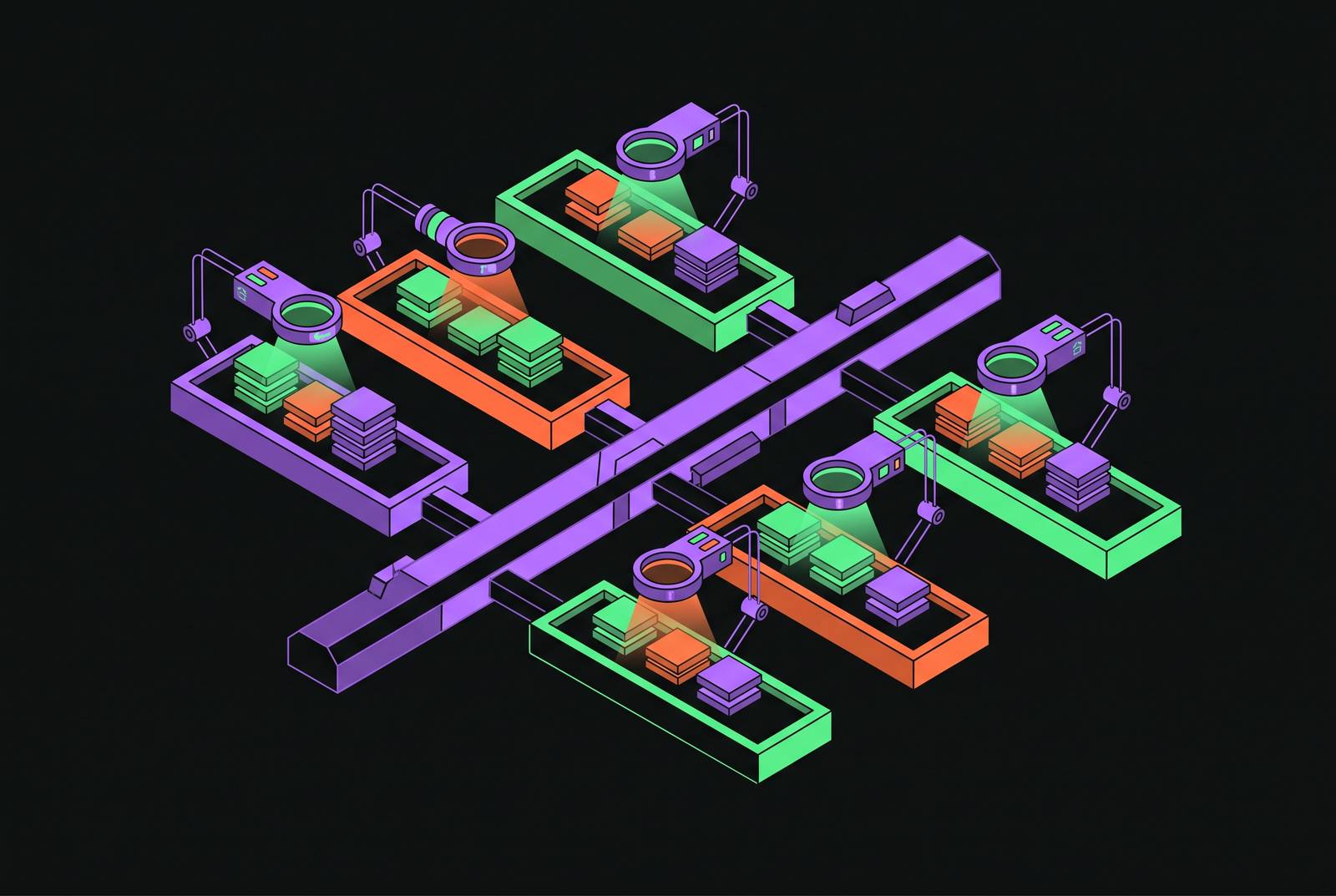
Running several coding agents against the same repository at once creates a version of a problem distributed-systems engineers have known about for decades: concurrent writers corrupting shared state. Git worktrees solve this by giving each agent its own branch and its own working directory, which turns invisible file collisions into merge conflicts that standard git tooling can actually detect. The distinction matters more than it sounds. A single agent working alone rarely runs into trouble, but the moment a second or third agent joins the same checkout, the failure modes stop looking like coding mistakes and start looking like race conditions.
The core practice is one task, one branch, one worktree, one agent. Running git worktree add -b feat/your-task../repo-feat-your-task main gives each agent its own working directory and staging area while sharing the underlying object store, which means concurrent git add and git commit operations never collide, and any conflicts between agents surface at merge time rather than silently mid-edit. Practitioners report a practical ceiling of five to seven concurrent worktrees on a typical laptop before API rate limits, disk pressure, and review overhead cancel out the throughput gains; sparse checkout (git sparse-checkout set <paths>) keeps per-worktree disk use proportional to the task rather than the full codebase. A WORKTREES.md tracking active assignments and an AGENTS.md defining file-ownership boundaries complete the setup, because worktrees isolate file writes but nothing stops two agents from being assigned conflicting work on the same module in the first place.
Four of those failure modes show up constantly in shared-directory setups. Two agents can read the same file, generate separate edits, and write back, with the second write silently winning and the first agent's work vanishing without an error. An agent can read another agent's uncommitted, half-finished changes and build its own reasoning on top of code that was never meant to be final. Concurrent git operations can collide on .git/index.lock, and whichever agent loses that race either aborts quietly or piles up uncommitted state nobody asked for. And any shared mutable resource, a build cache, a test database, a config registry, becomes a place where two agents can step on each other without either one knowing it happened.
None of this throws an exception. That's the part worth sitting with: the agent's context never sees an error, so it keeps working on corrupted assumptions and produces output that looks completely reasonable in isolation. A randomized controlled trial from METR found that experienced open-source developers using AI tools took 19% longer to finish tasks than developers working without them, largely because of time spent reviewing and debugging AI-generated code that interacted with the rest of the system in ways nobody predicted. Run several agents in parallel without isolation, and that same overhead compounds. These aren't failures of model quality or prompt design. They're structural, which means the fix has to be structural too.
What git worktrees actually are and why the object-store design matters
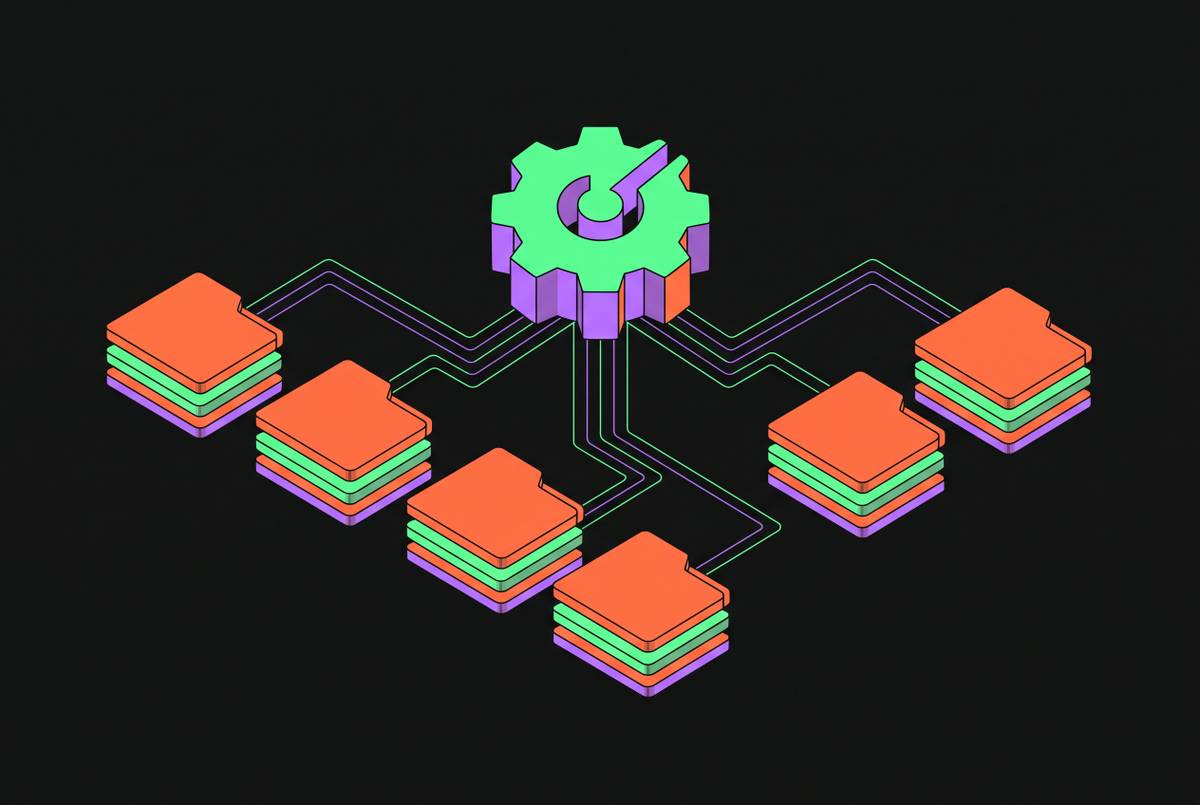
A linked worktree is a second checked-out copy of a repository. It points back to the main repository's .git directory through a small pointer file, and it shares that repository's object store, the .git/objects/ directory holding every commit, tree, and blob. What it does not share is the working tree or the index. Each worktree gets its own files on disk and its own staging area.
Sharing the object store is what makes the whole thing cheap. A file that's identical across three worktrees is stored once, not three times, and every worktree sees the full commit history and every remote instantly, with no syncing step required. Isolation, meanwhile, comes from the working tree and index being separate: changes made in one worktree stay invisible to every other worktree until someone merges them, and two agents running git add or git commit at the same time in different worktrees never touch the same staging area.
Git enforces one rule that does a lot of the heavy lifting here: a branch can only be checked out in one worktree at a time. Try to check out the same branch in a second worktree and git refuses outright. That single restriction rules out an entire category of divergence bugs before they can happen, because it's structurally impossible for two working copies to both claim ownership of one branch's history.
Without worktrees, three agents working three tasks leave a team with three options, and only three: run the agents one after another, clone the repository three separate times, or use worktrees. Sequential execution throws away the whole point of running agents in parallel. Cloning three times wastes disk, breaks the shared object store, and creates its own syncing headache when changes need to move between clones. Worktrees are the only option that gives isolation without duplicating the entire repository's history three times over.
What this buys, concretely, is a relocation of where conflicts get caught. Instead of surfacing silently while two agents are mid-edit, conflicts now show up at merge time, where git's own tooling flags them the way it always has for any two branches. That's the property that makes worktrees a genuinely safe primitive rather than just a convenient one. It leads to a rule simple enough to write on a whiteboard: one task, one branch, one worktree, one agent. Break that mapping, and the race conditions worktrees were built to prevent come right back.
The real cost of worktree isolation: disk consumption and the practical ceiling for parallelism
Isolation costs disk space, and the cost scales linearly with however many agents are running. A 2 GB codebase might produce a worktree closer to 5 GB once build artifacts, dependencies, and generated files land inside it. Run six agents concurrently and that's 30-plus gigabytes gone before any of them has written a single line of new code. This isn't a detail to discover after the fact; it belongs in the setup decision from the start.
Practitioner reports and the surrounding research converge on a rough ceiling of five to seven concurrent agents on a typical modern laptop. Past that point, rate limits on the underlying model APIs, disk pressure, and the sheer overhead of reviewing that many parallel diffs start eating whatever throughput gains parallelism was supposed to deliver. The bottleneck doesn't disappear beyond that ceiling, it just moves. Six agents finishing six pull requests at once still needs six human decisions at the other end, and that review capacity is its own limiting resource, not a free byproduct of running more agents.
One documented case pushed this to 371 simultaneous worktrees, an extreme cited in the literature to illustrate how far the underlying mechanism can scale, not as a workflow anyone should copy. Even there, the constraint at the human review layer doesn't go away; it just gets postponed.
The most practical mitigation for the disk problem is sparse checkout. Pairing git worktree add with git sparse-checkout set <paths> limits each worktree to only the files an agent actually needs, which matters enormously in a large monorepo where a single agent might only touch one service directory out of hundreds. It won't eliminate the per-worktree overhead, but it keeps it proportional to the task rather than to the size of the whole codebase.
Set against all this, the disk cost is a reasonable trade. There's no network overhead, no container to spin up, no VM to provision. Isolation happens entirely at the git layer, using tooling that's been battle-tested since worktrees landed in git years ago.
Setting up a multi-agent worktree environment: the lifecycle from creation to cleanup
Creating a worktree is one command: git worktree add -b feat/auth ../my-project-feat-auth main. The -b flag creates the branch and checks it out in the same step, so the directory and the branch come into existence together rather than as two separate operations that could drift apart.
git worktree list gives the at-a-glance view: every active worktree, its directory, its current commit, and its branch. That's the command to run before assuming a slot is free. Starting an agent inside a worktree is just a matter of navigating into that directory first; the agent sees an ordinary repository checkout and has no reason to know it's sitting inside a worktree rather than the primary clone.
Teams running this at any scale tend to script the whole lifecycle and commit that script to the repo, so every engineer creates and tears down worktrees the same way instead of improvising slightly different versions that eventually cause confusion. Cleanup itself isn't automatic: after a branch merges, someone has to run git worktree remove <path> and, usually, git branch -d afterward. Worktrees sit on disk until explicitly removed, so if removal isn't built into the workflow, disk usage only ever goes up.
Claude Code's native implementation handles this differently: a session that ends cleanly removes its own worktree and branch without anyone asking it to. That's a meaningful signal about where the tooling is heading generally, even outside that specific product.
A lightweight WORKTREES.md file, tracking active worktrees, their branches, which agent is assigned, what task it's working, and current status, solves a coordination problem git itself has no way to catch: two engineers accidentally launching agents against the same piece of work. And assignment matters as much as tracking. Splitting tasks by domain or functional boundary, rather than by file, means agents working on genuinely separate concerns produce genuinely separate diffs. Agents assigned overlapping logic will collide at merge time no matter how cleanly the worktrees themselves are isolated.
How dirty working trees and shared local config flow safely into agent worktrees
A common wrinkle: the user's main working tree often has uncommitted changes sitting in it when an agent session starts. The agent needs to see that same state, the code as it actually exists on the user's machine, not just the last commit. But copying those uncommitted changes into a new worktree carelessly risks polluting the user's own index in the process.
The KISS Sorcar pattern, described in the KISS Sorcar paper, handles this cleanly. The agent copies the uncommitted changes into its worktree and creates a baseline commit from them, so the agent's view of the code matches exactly what the user was looking at. At merge time, a cherry-pick from that baseline replays only the agent's own changes, leaving the dirty-state snapshot behind. The user's original uncommitted work is never touched. The same implementation encodes a chat ID and a timestamp directly into each branch name, so uniqueness and auditability come built into the naming convention rather than being bolted on afterward.
Local configuration raises a related but separate problem. Plenty of files are gitignored on purpose, per-machine settings, generated assets, local environment files, but an agent still needs them present to actually run the code. Claude Code addresses this with a .worktreeinclude file, written in gitignore syntax, that specifies exactly which gitignored files get copied into a new worktree.
Secrets are the one category that should never make that trip. They belong in a secrets manager, loaded at runtime, never copied onto disk inside a worktree directory, isolated or not. The underlying principle threading through both patterns is the same: an agent's worktree should faithfully represent the state the developer actually intended, without ever touching the developer's own index or exposing more than the agent needs.
Native worktree support in Claude Code and how other tools implement the same pattern differently
Worktrees moved from a practitioner workaround to a first-class product feature fast. Native support landed across major tools somewhere between October 2025 and February 2026, roughly a twelve-month window in which what used to be a manual git trick became something vendors build entire workflows around.
Claude Code's version covers several angles at once. Running claude --worktree feature-x (or the shorthand -w feature-x) creates a .claude/worktrees/feature-x/ directory on a worktree-feature-x branch and drops the session directly inside it. A PR mode, claude --worktree "#1234", fetches an existing pull request's branch and builds the worktree automatically, turning a full review setup into one command. Subagents declared with isolation: worktree in their frontmatter spawn their own worktrees, do their assigned work, and clean up after themselves. The .worktreeinclude file governs which gitignored files carry over into each new worktree, and a clean session end triggers automatic removal of both the worktree and its branch.
VS Code's Copilot CLI integration takes a different approach, offering two distinct isolation modes rather than one default behavior. Worktree isolation gives each session its own separate folder; workspace isolation keeps everything in the same folder and applies changes in place. In worktree mode, the agent commits at the end of every turn, and the resulting worktree shows up in the Source Control view's repository explorer, so a developer can watch multiple isolated sessions from one panel.
Editor support is catching up to the agent layer rather than leading it. VS Code added worktree support in July 2025. JetBrains followed with first-class worktree support in its 2026.1 release. The order matters: agents needed the isolation primitive first, and the editors are now building visibility into it.
KISS Sorcar takes the most opinionated stance of the group. Worktree isolation isn't a flag a user has to remember to set; it's baked in as one layer of a five-layer agent hierarchy, so every task gets its own branch and worktree by default, architecturally, without anyone opting in. The framework itself is compact, roughly 2,900 lines of code for its core agents, and according to the paper describing it, was built using itself over four months, worktree isolation and all.
What the empirical record on automated code review actually shows about agent output quality
The volume is no longer in question. OpenAI's Codex alone generated more than 400,000 pull requests across open-source GitHub repositories in under two months, a figure that puts agentic code contribution well past the experimental phase and into something closer to infrastructure.
Volume and quality are separate questions, though, and the data on quality is less flattering. The empirical study presented at MSR 2026, using a dataset of 19,450 pull requests called AIDev, found that PRs reviewed only by a code review agent (CRA) merged at a 45.20% rate, compared to 68.37% for PRs reviewed only by humans, a gap of just over 23 percentage points. CRA-only PRs were also abandoned at meaningfully higher rates.
The reason traces back to signal quality, not raw correctness. Among closed CRA-only pull requests, 60.2% fell into what the study classified as the 0 to 30% signal range, and twelve of thirteen code review agents examined averaged signal ratios below 60%. The agents aren't necessarily giving wrong feedback. They're burying whatever useful feedback exists under a heavy layer of noise, and reviewers have to dig for the parts worth acting on.
That finding sits uncomfortably next to vendor marketing. A 2025 claim from Qodo suggested code review agents could autonomously manage roughly 80% of pull requests in open-source repositories. The measured adoption rates and signal-quality numbers point the other direction entirely, and the gap between what's being sold and what's been measured is wide enough to notice.
Developers, for their part, have adapted by treating AI review comments as advisory rather than authoritative. Qualitative research on how engineers actually work with these tools shows selective integration: developers weigh each suggestion against their own context and trust in the source rather than accepting it outright. That approach cuts down on some of the interpersonal friction that comes with human code review, but it introduces its own cognitive tax, since every suggestion still needs to be checked before it's trusted. Separate research on agent-authored pull requests has raised questions about the durability of agent-generated code once it reaches human review, adding to that burden rather than reducing it, with code quality showing up as a recurring concern.
None of this argues against using these tools. It argues against replacing human review with them. Worktree isolation solves the structural problem of agents interfering with each other's work, but it has nothing to say about the separate problem of an agent's review comments being mostly noise. Those are two different failure modes, and fixing one doesn't touch the other.
How do you prevent multiple agents from being assigned conflicting work on the same module?
Worktrees isolate file writes. They do nothing to stop a team from assigning two agents to the same module in the first place, because the boundary worktrees enforce is the filesystem, not the semantic structure of the codebase. Two agents can have perfectly separate working directories and still end up building conflicting changes to the same authentication logic, just in different files that will collide the moment someone tries to merge both branches together.
AGENTS.md has emerged as the coordination layer that fills that gap. More than 60,000 open-source projects now maintain one, and the format has become a widely adopted community standard. Functionally, it's the file a modern coding agent reads on startup to learn what it's allowed to touch and what it has to leave alone.
A well-written AGENTS.md typically covers four things. File ownership rules spell out prohibited zones explicitly, migrations, vendor directories, payment modules, environment files, anything an agent should never modify regardless of what the task description implies. Build and test instructions state exactly how to install dependencies, build the project, run tests, and lint, so the agent isn't left guessing at commands. Commit and PR conventions cover branch naming, commit message format, and what a pull request description needs to include. And escalation guidance defines the conditions under which an agent should stop and ask a human rather than push forward on its own judgment.
An analysis covering more than 2,500 repositories found that the single most effective instruction pattern is explicit prohibition rather than general guidance. A direct line like "never commit secrets" outperforms a softer convention-based instruction, because agents respond reliably to a clear boundary and far less reliably to an implied one.
That points back to the same principle underlying task assignment generally: divide work by functional domain, authentication, the API layer, payments, rather than by individual file. Worktrees keep the writes apart. AGENTS.md keeps the intentions apart. Both are needed, because neither one solves the problem the other one is built for.