Running Codex Agents on Cloud Infrastructure at Team Scale
Teams must build governance infrastructure to safely run autonomous coding agents at scale.
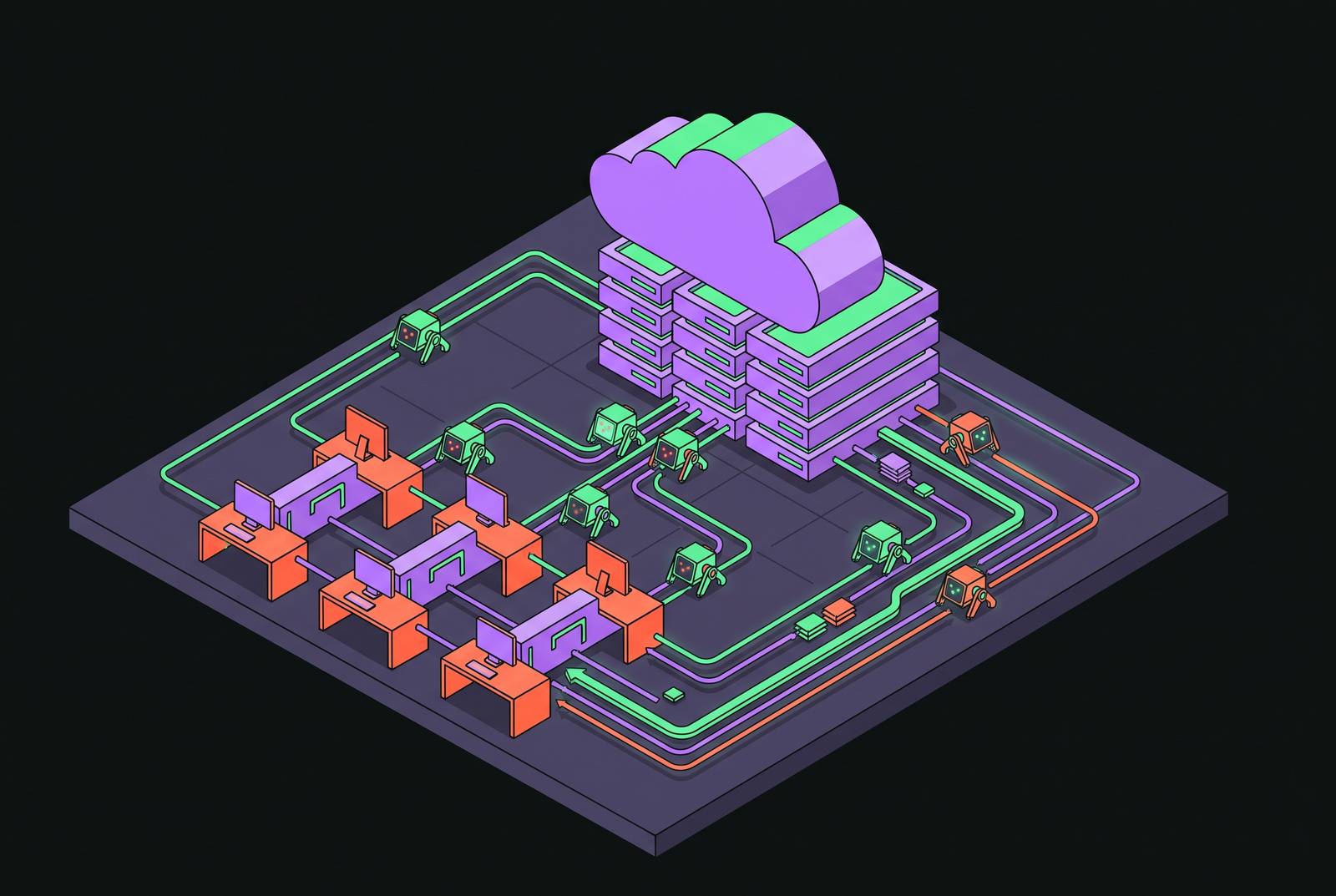
Codex in 2026 refers to an autonomous coding agent, not the 2021 code-completion API that shared its name, and teams still planning around the older product are planning around something that no longer exists. The distinction matters because the 2026 agent reads a repository, edits multiple files, runs tests, iterates on failures, and opens a pull request on its own, inside a sandboxed cloud environment, with no developer watching the intermediate steps. The deeper structural change is asynchrony, which produces the visible shift: a task gets submitted, the agent works unsupervised for minutes or hours, and a pull request arrives when it's done. There is no mid-execution checkpoint where a developer can redirect it.
That asynchronous, sandboxed design is what turns governance from a nice-to-have into the central problem of running Codex at scale. A developer using an AI assistant interactively produces work they watched unfold in real time, correcting course as they went. A cloud agent produces a pull request that a human must evaluate after the fact, with no record of the false starts or the discarded approaches unless something was built to capture them. Every governance question that follows in this piece, which credentials an agent holds, what its sandbox actually isolates, how its spend gets capped, what gets logged, becomes urgent the moment Codex moves from an assistant a person supervises to an agent that works alone and reports back.
The tasks where cloud Codex reliably delivers and the tasks where it does not
Before any governance control gets built, a team has to decide what kind of work belongs in the cloud-agent pipeline. Codex performs well on tasks that are well-scoped, verifiable by a test suite, and unlikely to need mid-course correction: updating test suites, migrating deprecated API calls, adding consistent error handling across services, writing documentation from code that already exists, and implementing feature requests where the scope and acceptance criteria are already specific. Dependency upgrades and code style migrations, such as moving a codebase from callback-style asynchronous code to async/await, sit at the center of this category. They're clearly bounded, their success or failure is measurable by running the existing test suite, and they rarely require a human to step in partway through.
The same architecture that makes those tasks reliable makes other tasks poor fits. Real-time pair programming is off the table too, because the cloud agent doesn't offer inline autocomplete the way an interactive assistant does.
None of this is a limitation to apologize for. It's a routing decision. Codex's parallel execution, running several tasks simultaneously, each in its own sandboxed environment, is the headline reason teams adopt it at scale, but that same parallelism multiplies whatever comes out the other end. Knowing which tasks to send into that pipeline, and which to keep inside an interactive, human-supervised workflow, is the first governance decision a team makes, well before anyone touches a credential policy or a budget cap.
The Review Bottleneck as the Binding Constraint at Team Scale
Once a team has routed the right tasks to cloud agents, the limiting factor is no longer what the model can do but how fast humans can responsibly evaluate what it produced. An interactive agent generates work its author already understands, because they were there while it happened. A cloud agent generates a pull request that a reviewer has to assess cold, with no shared context for why a particular approach was chosen over another.
That gap compounds with scale. Ten parallel cloud agents, each working a separate task in its own sandbox, produce ten cold pull requests arriving around the same time, and the review burden grows in direct proportion to the throughput gain. Without audit trails, logged tool calls, diffs, and the reasoning steps the agent took along the way, reviewers are left approving output they cannot trace back to a decision process. That is a different kind of review than looking at a colleague's pull request, where the author sits two desks away and can answer a question in thirty seconds.
Northflank's enterprise deployment guide treats audit logging, secret scanning on agent pull requests, and PR policy gates as non-negotiable controls for deploying AI coding agents in an enterprise setting, so they aren't optional add-ons layered on later. That framing is correct because the alternative is a review process that looks rigorous but isn't: a human clicking approve on something they had no real way to verify. The answer to the review bottleneck is giving reviewers the traceability, what files were read, what commands ran, what the agent tried before arriving at this diff, so they can approve with actual confidence. Every control discussed from here forward exists to serve that one purpose.
Credential scoping: why ambient authentication is the default failure mode
The most acute risk in a default Codex deployment is credential scope, because the default setup inherits whatever authentication the developer already has sitting on their machine. CUT
Ambient credentials accumulate quietly over time. An agent doesn't need malicious intent to misuse that access. It only needs a task that touches more of the environment than the developer anticipated.
The architecture that actually solves this issues short-lived, task-scoped credentials: the agent gets read access to the specific repository it's working in and nothing beyond that, and anything requiring broader access gets escalated to a human for explicit approval. Most teams running Codex at scale today are doing so without the identity controls their risk exposure actually calls for.
If a credential leaks under that model, you get an incident with a defined, bounded scope, not an open-ended exposure that persists until someone notices and manually revokes it.
Sandbox isolation: what the Codex execution environment guarantees
Codex's native sandbox isolates the filesystem and network on a per-task basis, but that isolation stops well short of the organizational controls a production deployment needs. Each task runs inside its own cloud sandbox environment, a microVM with its own filesystem and its own git state, separate from any other task running in parallel. In workspace-write mode, the agent can edit files directly in the local working tree. What gets accepted into the actual codebase is governed by a separate approval policy, distinct from the sandbox itself. The sandbox's VM state persists for a limited period after the last turn or after a task is resumed, and then it's gone.
Network isolation is deliberate rather than incidental: Codex cannot exfiltrate code, call out to external APIs without explicit configuration, or introduce a supply chain risk through unplanned network calls during normal execution. That's a genuine security property, and it covers a real class of threats.
It does not cover several others. The native sandbox provides no budget caps, no organizational audit log that a security team's SIEM can query, no secret scanning before a pull request merges, no PR policy gates, and no model routing across different kinds of tasks. Teams tend to hear "sandboxed" and assume that means "governed," and that assumption is where the gap opens up. The sandbox answers the question of whether one task can interfere with another or reach outside its own filesystem. It does not answer whether the organization can control what the agent costs, see what it did across every task it ran this month, or stop a pull request that happens to contain a leaked API key. Those are the responsibilities that fall to infrastructure the team has to build or buy on top of what Codex ships with.
Spend control: why token volume makes budget enforcement a structural requirement, not a monitoring task
Agentic workflows consume tokens at a volume that doesn't resemble ordinary chatbot usage, and that difference changes what a responsible budget control actually has to look like. Falling per-token prices get absorbed by higher task volume, so total bills stay the same.
An autonomous agent can burn through a substantial amount of compute spend in minutes, but cloud billing runs on hourly or daily cycles. By the time a billing dashboard reflects what happened, the overage has already occurred, and monitoring after the fact can tell a team what went wrong but can't have stopped it.
The architecture that actually controls cost sits in front of the spend rather than behind it: a central budget manager, backed by a persistent store, reserves funds before each call goes out, reconciles actual usage afterward, and blocks any action that would exceed budget rather than merely flagging it once it already happened. Four levers, applied in order, produce the largest gains: model routing, prompt caching, context window management, and hard budget caps, and together they can bring about a substantial reduction in production costs. Model routing deserves particular attention because it's the lever most teams skip. An interactive developer picks one model and uses it for everything. A cloud pipeline doesn't have to: it can route simple triage work to a cost-effective model, hand implementation work to a mid-tier model, and reserve the frontier model for genuinely architectural decisions.
Enterprise AI gateways have emerged specifically to enforce this kind of policy in one place rather than scattering budget logic across every codebase that calls a model. For that control to work, caps need to apply at more than one level at once, per session, per developer, and per billing period, because a per-developer cap alone won't catch a runaway automated pipeline that isn't tied to any single person's usage pattern.
Audit trails: the observability requirements and the SIEM integration bar for SOC 2
A pull request an agent produced is auditable only if every action behind it is logged and queryable, down to the file reads, shell commands, and reasoning steps that led to the final diff. For a SOC 2 Type 2 audit specifically, that standard carries a sharper edge: the requirement is demonstrable evidence that controls operated consistently across the entire audit period, not evidence that they happened to work the day an auditor looked.
The practical floor for this is that every file access, every shell command, every pull request creation, and every API call flows into the organization's SIEM, where a security team can actually query it, rather than sitting in a proprietary dashboard that an auditor has no way to inspect. A log a team can produce on demand when someone asks doesn't satisfy SOC 2 Type 2's continuous-operation standard, because a spot check says nothing about what happened across the rest of the audit period.
This isn't a future compliance concern teams can defer. HIPAA, GDPR, and SOC 2 constraints already apply to how cloud agents process code today, and they need evaluation before an agent gets enabled on a production repository, not after. The regulatory calendar has moved too: the EU's Article 50 transparency rule, requiring disclosure around AI system use, took effect on August 2, 2026, and the broader Annex III compliance deadline lands on December 2, 2027. Any team running Codex against production repositories right now is already operating inside that disclosure window. Microsoft's response at Build 2026, introducing Purview runtime data loss prevention for agent prompts in preview, detecting, blocking, and auditing sensitive data before the agent processes it, is a platform-level acknowledgment that this logging requirement is now a baseline expectation.
The practical test for whether an audit trail is doing its job is attributability: every tool call and every diff needs to trace back to a specific person or a specific trigger, not simply to "the agent," because when something goes wrong the first question anyone asks is who authorized it and what it touched. That standard is also what makes the review bottleneck tractable. A reviewer evaluating a cold pull request can approve it with real confidence only if the trail behind it is complete enough to answer that question without guessing.
AGENTS.md as the configuration layer that makes governance repeatable across the team
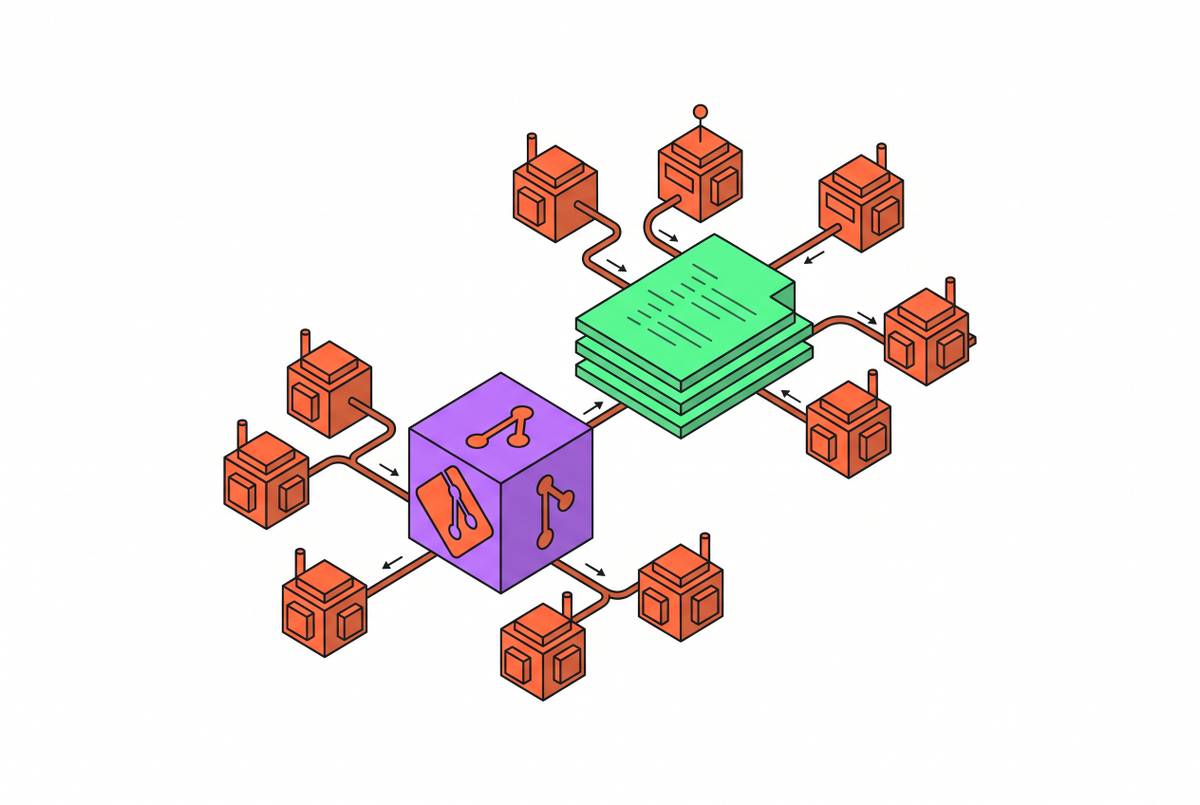
Every control described so far, credential scope, sandbox boundaries, budget enforcement, audit logging, has to be configured somewhere, and configuring it separately for every repository and every developer is how governance quietly erodes at scale. A configuration file committed to the repository gives a team a single, version-controlled place to declare how an agent should behave in a given repository: which commands it's permitted to run, which directories are off-limits, what test suite it has to satisfy before a pull request is considered complete, and what approval policy governs its changes. Because the file lives in the repository itself, it travels with the codebase rather than depending on an individual developer's local setup or memory.
Credential scoping is only durable if the scope is defined somewhere a new team member, or a new sandbox instance, can pick up automatically. Review trust depends on every agent in the organization operating under the same baseline expectations, not on each developer configuring a slightly different set of guardrails. A shared configuration layer is what makes an audit trail meaningful at the organizational level, because it lets a security team point to one declared policy and verify, repository by repository, that agent behavior actually matched it. Without that layer, each of the controls discussed here, credential scope, sandbox limits, spend caps, logging requirements, exists as a one-off decision somebody has to remember to re-apply. With it, governance becomes a property of the codebase rather than a property of whichever engineer happened to set it up that day.